Friday, 30 June 2006

Spectacular bloomers

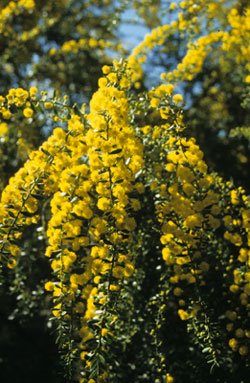
My slide scanner arrived today, so I'm trying it out. Here are a couple of photos from my garden. (I've cheated a bit. I took them last year.) Acacia acinacea, the gold dust wattle, flowers in late winter. At the moment, the two in my front garden are covered in buds and the first few blossoms have appeared. Soon, they'll be glowing so brightly I can spot them from the end of the street.

Hakea laurina, the pincushion hakea, flowers in late autumn. Unlike A. acinacea, this species is not native to Victoria. It occurs in SW Western Australia, where it thrives on a variety of soils.

I have a real soft spot for hakeas. (And Casuarinaceae. And Lasiopetalum. And Kennedia. And ... the list goes on.) I really need to move to a bigger block so I can indulge this interest!

Thursday, 29 June 2006

Sunlight at the okay coral

Snippets from current journals

In deep water

Reef-building corals have an intimate relationship with microscopic algae. (Relationships don't get more intimate than this—the algae are embedded in the coral's tissues.) Algae provide their host with food, the host supplies carbon dioxide. It's all very cosy.

The algae (zooxanthellae) assist the coral to build its skeleton by increasing the rate at which calcium carbonate is laid down. They allow their slowcoach associates to compete with faster-growing organisms that might otherwise smother them. If you wander out to a reef, you'll see how successful the relationship is. As far as coral is concerned, zooxanthellae are life-savers.

But the success of the relationship depends more on the zooxanthellae than on the corals. Photosynthesis is the key. This is the biochemical process by which algae and plants harness light energy to power their production of carbohydrates. The problem is that light decreases with depth. It's fine at the surface but at some point the light becomes so weak that it can't provide the energy required. Photosynthesis stops. Reef building grinds to a halt.

Around the continental shelf, the water is turbid and murky with nutrients. Light doesn't get too far. But in clear oceanic waters, light penetrates much. Around the mid-ocean islands of Hawaii, reef-building corals live as deep as 120 m. At Johnston Atoll, in the middle of the Pacific, the coral Leptoseris hawaiiensis grows even further down at 165 m. That's a long way.

Reference
Kahng, S.E. & Maragos, J.E. (2006). The deepest, zooxanthellate scleractinian corals in the world? Coral Reefs 25: 254–254


Some day my alga will come

How do zooxanthellae get together with their hosts?

If a new polyp is formed by budding from another one, the zooxanthellae are passed down from the 'parent'. They like to keep it in the family—a functional heirloom. But if a new colony results from sexual reproduction (a fertilised egg becomes a mobile planula that settles to produce polyps), the zooxanthellae has to make a big effort.

They follow chemical cues in the water. The zooxanthellae pick up the waterborne scents of corals and swim towards the source. Not very quickly, admittedly but they're okay in currents up to 0.5 mm/s. (If you want to see that in other units, do the maths yourself.)

It's easy if a virgin polyp is nearby. What happens if it's too far away? If the zooxanthellae are wandering in a chemical free zone? They keep swimming but they turn a lot. Sure, they don't travel a huge distance from where they started (as the clownfish swims) but they do cover a great deal of territory while not getting anywhere.

Reference
Pasternak, Z., Blasius, B. Abelson, A. & Achituv, Y. (2006). Host-finding behaviour and navigation capabilities of symbiotic zooxanthellae. Coral Reefs 25: 201–207.


Stressed out

When reef-building corals are stressed they evict their algal chums. Empty of photosynthetic zooxanthellae, the polyp tissues turn pale. This is the phenomenon known as coral bleaching. (Few corals are coloured. In most cases, the hues of living animals are due to their symbiotic algae.)

Among the hardest hit is the fire coral, Millepora. Exposed to higher than normal temperatures (thank you, global warming), Millepora ejects its zooxanthellae without a by your leave. Colonies often succumb to the stress. Millepora seems to take it harder than other corals. But it also springs back quicker than the rest. Easy come, easy go.

Reference
Lewis, J.B. (2006). Biology and ecology of the hydrocoral Millepora on coral reefs. Advances in Marine Biology 50: 1–55.

Join the Indigenous Flora and Fauna Association

The Indigenous Flora and Fauna Association is a nationwide group dedicated to understanding and conserving Australia's native plants and animals. (And the other groups—especially fungi. (Heck, do these people love their fungi!)

IFFA's aims and objectives are to promote the appreciation, study, conservation and management of indigenous flora and fauna through:

  • research and discussion;
  • networking and advocacy; and
  • information exchange.

They run workshops and seminars and have a good time while doing all of the above.

Check out IFFA's website here. (I've put the link up over there too →)

Wednesday, 28 June 2006

Aussie! Aussie! Aussie! Tweet! Tweet! Tweet!

For a ridiculously long time, biogeographers viewed Australia as a benign Jurassic Park. A place in which the oldest, most clapped-out animals survived long after their use-by date because they were isolated by the ocean from the latest models in the Northern Hemisphere. No velociraptors, just emus. No Triceratops but platypus and echidna. And wombats.

(Now there’s an antipodean oddball—the wombat. Pre-Raphaelite artist Dante Gabriel Rossetti kept a wombat at his house in Cheyne Walk, Chelsea. He opined they were ‘the most beautiful of God’s creatures’. But I digress.)

After breaking free from the remnants of Gondwana, Australia slid inexorably northwards. As it neared the edge of Asia, the flash, new, improved flora and fauna crossed the moat. A sort of gravity-fed colonisation as species first dripped and then cascaded down the map.

That was the story.

The perching birds tell a completely different tale.

Almost 60% of the world’s bird species are perching birds—passerines. Swallows, warblers, thrushes, starlings, sparrows, finches, wagtails, crows ... That’s 5800 species, give or take a few. Among them, the oscines (the largest group at almost 4600 species) originated in Australia and spread to the rest of the world.

The oscines arose more than 66 million years ago, when Australia was still a long way from the northern land masses. The birds diversified in isolation for at least 20 million years. (There was some dispersal to New Zealand during that time.) Then they made a break for it, spreading north and west.

We know that crows and their allies started flapping across the islands squeezed into archipelagos by the converging Australian and Asia boundaries. They dispersed across the rest of the world from South East Asia.

But this is the odd bit. Another group seems to have spread from Australia to Africa without travelling through Asia. Do not pass Go. Do not collect $200.

Some of the oldest non-Australian genera (e.g. Hyliota) occur in southern Africa. Many others are widespread but are curiously absent from Wallacea (the biogeographical area between Asia and Australia). Surely, if they had dispersed through South East Asia they would still occur there—unless they had all become locally extinct. And what are the odds of that?

The evidence for a trans-Indian Ocean dispersal event is not conclusive. The researchers (Knud Jønsson and Jon Fjeldså of the University of Copenhagen) aren’t yet convinced but it’s an interesting idea. I’ll keep an eye on this one, the In to Africa hypothesis.


Read more
Jønsson, K.A. & Fjeldså, J. (2005). A phylogenetic supertree of oscine passerine birds (Aves: Passeri). Zoologica Scripta 33: 149–186.

Jønsson, K.A. & Fjeldså, J. (2006). Determining biogeographical patterns of dispersal and diversification in oscine passerine birds in Australia, Southeast Asia and Africa. Journal of Biogeography 33: 1155–1165.

Sibley, C.G. & Ahlquist, J.E. (1990). Phylogeny and classification of birds. Yale University Press, New Haven, CT.

Tuesday, 27 June 2006

Burke and here

The new James Lee Burke novel, Pegasus Descending, is due out next month. That's the hardback edition in the US. I'm not sure if there's a simultaneous release in paperback over there. I do know that it'll be months before it gets here in either form.

New mid-year resolution: Give up looking at book reviews in overseas newspapers. There's a real frustration in reading through the Guardian or the New York Times and finding a whole bunch of books that sound fantastic but aren't yet available on this side of the world. There's always amazon.com or amazon.co.uk. Or patience.

Burke's novel is another in the Dave Robicheaux series. I expect something dreadful will befall our Cajun hero but it's difficult to imagine what fate will bring. He's already married and buried three women. (I think that's right. It could be more. It could be fewer.) God knows how many people he's knocked off in the line of duty. He and buddy Clete Purcell must be getting commissions from the funeral parlours at New Iberia. Sure, the violence is theatrical. But Burke can write. Especially descriptions.

He is an expert in the telling detail. When he describes the Louisiana bayous or decaying mansions, he avoids the obvious. He lets you fill in the features you already know—the whitewash peeling from the walls, the bruised camellias. Burke concentrates on the elements that distinguish this setting from the clichés. The real details.

Here's an excerpt from Jolie Blon's Bounce (2002).

Her body was found just before dawn the next morning by a black man who was running trotlines in the swamp. The sun was still low on the horizon, veiled in mist, when Helen Soileau and I boarded a St. Martin Parish Sheriff's Department boat with two detectives and the coroner and a uniformed deputy from St. Martinville. We headed up Bayou Benoit in the coolness of the early morning, between flooded woods and through bays that were absolutely silent, undimpled by rain or ruffled by wind, the willows and gum trees and moss-hung cypress as still in the green light as if they had been painted against the sky.

The uniformed deputy turned the boat out of the main channel and cut back on the throttle and took us through a stand of tupelo gums that were hollowed out by dry rot and whose trunks resonated like drums when the boat's hull scraped against them. Then we saw the desiccated remains of a houseboat that had lain twisted inside the trees since Hurricane Audrey had struck Louisiana in 1957, its grey sides strung with blooming morning glories.

This is the opening of a scene. The first paragraph is smooth but not too exciting. That second paragraph does it for me. The hollow trees. The stranded houseboat. The morning glory. The rhythm of the words. Great stuff.

Dear Diary ...

I don't think I've quite got the idea of this blog business. It's supposed to be a web log, right? An on-line diary? I suppose I should talk a bit more about what's going on around me, not restrict it to stuff that's caught my eye recently.

Well, let's see, what happened today?

I failed to stay up to watch the Australia v Italy match in the World Cup. Although I didn't really believe we'd win*, I rather hoped we might sneak through on penalties. You know the story.

I had a brief burst of energy this morning and spent twenty minutes on the exercise bike. Pedalling, that is. I didn't just sit there reading. (But I did get through more of Peter Temple's The Broken Shore. I'm enjoying it so much, I don't want to finish it. Does that make sense?)

A flurry of e-mails pinged into my inbox at lunch time. I had to organise what used to be called an examiners' meeting and is now something along the lines of a student progress board meeting. (The abbreviation is ASPB but I'm damned if I can remember what the A stands for.) To get a quorum for one of these exciting events, we need six people, four of whom are ... oh, it's all too horrible. It doesn't sound too gruesome but it's like a volcano. If you think that the effluvium that comes out of the crater is bad enough, just wait for the pyroclastic cloud. (Does that work? Maybe not. I'll have to go off and polish my lava analogies.)

Having dealt with that nonsense as well as I could, I went for a brisk walk around campus. When I arrived at the hospital psychiatric ward, I thought it was time to return to the office. (Either that or I was convinced I was already back at work.) That invigorated me enough to take care of the next bit of silliness to arrive in the inbox.

I entertained myself briefly by planning a project on cataloguing post mortem artifacts in submerged corpses. This required looking at pictures of dead folks who had their faces chewed off by all manner of mammals. (Mice are much more effective at cleaning flesh off bone than are pit bull terriers. Useful tip.) Then I lost the momentum when I couldn't think of how to get hold of some neonate piglets (dead) to use in the study.

Yes, it's all fun and games at work.

In the world of not-work, the writing is proceeding in fits and starts. I'm chugging through two projects simultaneously—a non-fiction, popular science manuscript and a crime fiction manuscript. I'm not sure having two MSS on the go is the most successful strategy. But who knows? Neil Gaiman says he runs a brace of books, so he can switch between them when he suffers from writer's block. Of course, he's sticking to one genre. And he's a professional. I'll see how it proceeds. If it all ends in tears, you'll hear about it.


*Note the 'we'—if there's a band wagon, I'm riding up front with the driver.

Ant-ics

Many species of blue butterflies (Lycaenidae) have something going with ants. The adults are free-flying but caterpillars live in ant nests. Mostly the relationship is mutualistic—ants shield caterpillars from predators and parasites, caterpillars provide ants with a sugar secretion. (Protection honey?) And sometimes it all goes horribly wrong for one partner. The ungrateful moth butterfly (Liphyra brassolis) dines on its benefactors.

Ant-friendly caterpillars release a pheromone from tiny glands called pore cupola organs. The scent encourages ants to tolerate the caterpillar. (It has been described as an appeasement or adoption signal.) Instead of feeding on the intruder, their attention is rewarded with food. Each caterpillar has a dorsal nectary organ that exudes a liquid rich in sugars and amino acids when prompted. It’s a fair exchange.

Caterpillars of the ciliate blue butterfly (Anthene emolus globosus) live with green tree ants (Oecophylla smaragdina). These ants occur throughout SE Asia and tropical Australia, where they build nests from leaves sewn together with silk produced by their own larvae. They are aggressive, active and willing to bite. If sinking the jaws in isn’t enough to deter an enemy, they spray formic acid as well.

Anthene caterpillars are flat and slug-like. They produces ant-nosh at a high rate200 to 300 droplets an hour. They also drum to attract ants, just in case the food and pheromone aren’t enough.

Ants keep the big predators away—only the brave or foolhardy will take them on—but they aren’t always so effective at deterring the smaller ones. Braconid wasps are parasitoids. (Parasitoids have life cycles similar to those of parasites but there’s always an unhappy ending for the host.) Adults lay eggs on or in caterpillars and other insects. The wasp larva hatch and develops inside the caterpillar, eating its way through the internal organs as it grows. Eventually, the larva pupates and metamorphoses into an adult wasp. Depending on the species of parasitoid, the caterpillar may be dead before the wasp pupates. Or not. (The life cycle of Dan O’Bannon’s Alien was based loosely on that of parasitoid wasps. Real parasitoids are much worse on their own miniature scale.)

When the braconid Apanteles emerges from Anthene, it spins a cocoon beneath the caterpillar. The host remains partly functional for a long while after. The DNOs secrete sugary fluid for up to three days but the caterpillar corpse remains attractive to ants for another one or two days. Drumming continues unabated by a lack of insides. (It eventually stops after three to five days.)

The braconids dine on their hosts. At the same time the ants protect them from hyperparasitoids while they are pupating. (Hyperparasitoids specialise in giving parasitoids a taste of their own medicine.) The caterpillars finally cease the ant-attracting activity a day or two before the wasps emerge from their cocoons. Apanteles is then free to go about its business—looking for hosts for the next generation.

It’s a jungle out there.


Read more
Fiedler, K., Seufert, P., Pierce, N.E., Pearson, J.G. & Baumgarten, H-T. (1992). Exploitation of lycaenid-ant mutualisms by braconid parasitoids. Journal of Research on the Lepidoptera 31(3-4): 153–168.

Saarinen, E.V. (2006). Differences in worker caste behaviour of Oecophylla smaragdina (Hymenoptera: Formicidae) in response to larvae of Anthene emolus (Lepidoptera: Lycaenidae). Biological Journal of the Linnean Society 88: 391–395.

Monday, 26 June 2006

One for the library

Ropohl, D., Scheithauer, R. & Pollak, S. (1995). Postmortem injuries inflicted by domestic golden hamster: morphological aspects and evidence by DNA typing. Forensic Science International 72: 81–90.

Thursday, 8 June 2006

Margaret Atwood at the Hay Festival

(I couldn't be bothered creating a whimsical title.)

The Hay Festival (at Hay on Wye, Wales) is over for another year but the stories linger. Canadian author Margaret Atwood wrote a few pieces about it for the Guardian. You can read her blog here.

This bit about the new conservative young 'uns really tickled me.
Everyone was genial. Gone are the days, it seems, when authors would yell at each other or get blind drunk and fall backwards out of plate-glass windows. Or maybe the younger generation saves that part until after I have gone off to bed. Rumour has it that there was dancing.

Nah. They were probably all sitting around in their Peter Alexander pyjamas and fluffy bunny slippers, sipping hot chocolate with marshmallows.

A really cool rainforest

(Actually it's a really cold rainforest right now. But there's no better time to visit.)

I love the rainforests. That's lucky, really, because I spend a lot of time in them, looking at the fauna, falling over the flora and trying to piece together their history from the late Mesozoic to the Pleistocene.

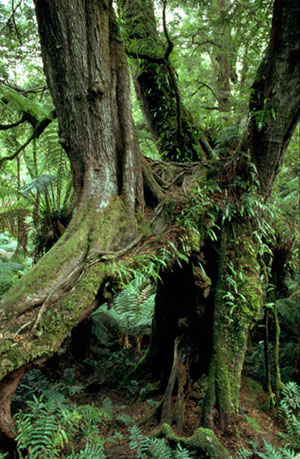
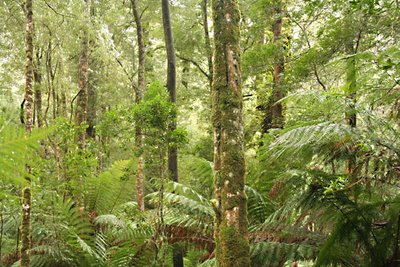
Most of my studies have been in vine forest and vine thicket (dry rainforest) in tropical Queensland. (When I get the scanner—currently on order—I'll put up the pictures.) Now I'm interested in Victoria's cool temperate rainforests, particularly the Myrtle Beech forests of the Otway Ranges.

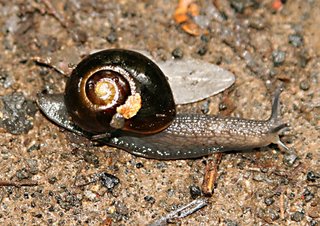
You probably won't be surprised that the Otway forests are home to a number of endemic species, including a black snail (Victaphanta compacta) (see the article below), stonefly (Eusthenia nothofagi)*, caddisfly (Taskiria otwayensis), burrowing cray (Engaeus fultoni) and grey gum (Eucalyptus aff. cypellocarpa). The Grey Gum is a bit iffy, though. It may or may not be different from the Mountain Grey Gum (Eucalyptus cypellocarpa). The animals are okay, though. They are definitely short-range endemics.

Why do the Otway forests contain so many species that are found nowhere else? The first thing to establish is that isolated blocks of forest often have endemic species. This is nothing unusual.

Rainforests require a high rainfall. (File that under B for the bleedin' obvious.) During the Pleistocene ice ages, the climate was cool and dry and not at all favourable for them. The forest contracted into patches—each patch an island surrounded by a sea of dry-adapted vegetation. Over time, populations of species in the forest islands reacted in exactly the same way as would populations on oceanic islands. Some went extinct because the islands had insufficient resources to support them. Others persisted.

Of the ones that persisted, some were able to move between patches. They maintained a flow of genes between populations so there was no differentiation. The forest patches may have been isolated but the animals (or plants) weren't.

You can see what would happen to those that couldn't move. No exchange of genes with other populations meant that they developed in isolation. Over time each isolated population differentiated from the others. This is probably what happened among the endemic invertebrates in the Otways.

The next step is to use morphological and molecular information about each group of animals (Victaphanta snails, Eusthenia stoneflies etc) to reconstruct their evolutionary history. Then we can see which species are most closely related to those from the Otways.

Which rainforest holds the sister species? I'm putting some money on the Central Highlands of Victoria. But I'm saving a bit for the Tasmanian west coast.


*remind me to tell you the tale about how the presumed extinct Otway Stonefly was found alive and well by a scientist on holiday.

[Thanks to MM yet again for the photograph of the Myrtle Beech forest in the Otways. I think that's somewhere around Mait's Rest. Or Melba Gully.]

Monday, 5 June 2006

Killer snails

It's cold in Melbourne at the moment. And that means it's freezing in the Otway Ranges. Just the right weather for the Black Snail (Victaphanta compacta). They love it cool.

If you visit the magnificent myrtle beech (Nothofagus cunninghamii) and Blackwood (Acacia melanoxylon) forests of SW Victoria at this time of year, might be lucky enough to spot one of these snails. They are often found crawling across the tracks at (Mait's Rest and Melba Gully. (The snails are crawling, that is. Although you might try looking for them while you're on your hands and knees.)


The Otway Black Snail belongs to the Rhytididae, a family of carnivorous snails with a Gondwanan origin.

Rhytidids feed on worms and other snails. They snare prey on their sharp teeth and drag it back into the mouth. It's not quite Alien but it's pretty gruesome on a small (and slow) scale.

Other species of Victaphanta live in closed forests of the Dandenong Ranges and in Tasmania. In Australia, rhytidids are found in the forests and dense scrub along most of the coast. Elsewhere they occur in South Africa and New Zealand, where they grow to a huge size. (And eat whatever they like.)

[Thanks, once again, to MM for the great photograph of the OBS]

Sunday, 4 June 2006

Ring them bells

I visited Kangaroo Island, South Australia, a few weeks ago with a bunch of friends. We had a picnic at Point Ellen on the island's south coast. Point Ellen lies at the western edge of Vivonne Bay, recently voted the world's best beach apparently. It's not bad, I guess, but there's a lot of nice beaches around Australia. Broad expanses of sand don't do much for me.

Vivonne Bay is interesting for more than its pulchritudinous shoreline. It is the type locality for the Point Ellen formation, which was laid down in the Early Pleistocene during a period of higher sea level. The rocks are stuffed full of shells. Most of them are bivalves, almost as big as your outstretched hand, but there are also many snails. Among them is Nerita milnesi Ludbrook, an extinct relative of Nerita atramentosa Reeve. Nerita atramentosa is almost ubiquitous on rocky shores in southern Australia and New Zealand. Nerita milnesi seemed to have been equally abundant in the Early Pleistocene but has now disappeared.


Campanile symbolicum Iredale is also found as a fossil in the Point Ellen formation. The picture above shows a shell that has been worn away along the midline. Those circles are cross-sections through the whorls. (For scale, those small grey littorinid shells are about 1 cm long.)

Unlike N. milnesi, C. symbolicum is alive and kicking. Well, crawling. Since the Pleistocene, its range has shrunk in a serious way. Although no longer occurring at Kangaroo Island, it is still found in SW Western Australia between Geraldton and the Recherche Archipelago.

Campanile is the only surviving member of the Campanilidae, a family that thrived in the late Mesozoic and early Cenozoic. It's been suggested that the family's dramatic decline in diversity might have been due to competition with other herbivorous snails (conchs in the family Strombidae). But no one really knows. It's nice to think that they're still hanging on in Australia.

[A huge thanks to MM for providing the photograph of C. symbolicum]

Read more
Houbrick, R.S. (1981). Anatomy, biology and systematics of Campanile symbolicum with reference to adaptive radiation of the Cerithiacea (Gastropoda: Prosobranchia). Malacologia 21: 263–289.

Ludbrook, N.H. (1983). Molluscan faunas of the Early Pleistocene Point Ellen formation and Burnham Limestone, South Australia. Transactions of the Royal Society of South Australia 107(1): 37–49.

Ludbrook, N.H. (1984). Quaternary molluscs of South Australia. Department of Mines and Energy, Handbook no. 9.

Milnes, A.R., Ludbrook, N.H., Lindsay, J.M. & Cooper, B.J. (1983). The succession of Cainozoic marine sediments on Kangaroo Island, South Australia. Transactions of the Royal Society of South Australia 107(1): 1–35.

Saturday, 3 June 2006

Drops of mercury

Naming new species seems like a lot of fun ... until you have to do it. Using someone's name is always a good way out. Lots of species are named after their collectors, notable researchers (amateur or professional) or the author's friends and relatives. But the new species and the honoured person don't necessarily have to be connected in any way. That's the author's prerogative.

At least three species (a crustacean, a diatom and an insect) are named after Queen's Freddie Mercury. (Okay, I'm not sure about the insect—see below.) All were described after his death in 1991.

Crustacean biologist Niel* Bruce described an isopod from the waters of Bawe Island, Zanzibar. He called it Cirolana mercuryi because Mercury was 'arguably Zanzibar's most famous popular musician and singer'. Arguably? How many other famous popular musicians and singers have come out of Zanzibar? (Answers, please, on a post card to Niel, not me.)

The world of algae brings us Achnanthes mercuryi Witkowski, Metzeltin & Lange-Bertalot, a diatom from the Norwegian territory of Svalbard. This species was named after Mercury in remembrance of all AIDS sufferers.

There's a species of Italian stonefly called Taeniopteryx mercuryi Fochetti & Nicolai, which is endemic to the Abruzzo Mountains of central Italy. (But I'm not certain that it is named after the singer. I couldn't find any references on the Web so I may be forced to do things the old-fashioned way—go to a library.)

Now this raises two questions in my mind. 1) What would Mercury have thought about it? That is, of course, unanswerable. 2) Are there any species bearing the names of other members of Queen? I'm off to have a look.

*Yes, that's how it's spelled.


Read more
Bruce, N.L. (2003). Cirolana mercuryi sp. nov., a distinctive cirolanid isopod (Flabellifera) from the coral reefs of Zanzibar, East Africa. Crustaceana 76(9): 1071–1081.

Fochetti R. & Nicolai, P. (1996). The genus Taeniopteryx in Italy: biochemical and morphological data with the description of Taeniopteryx mercuryi n. sp. Bulletin de la Sociéte Entomologique Suisse: 69: 95–106.

Witkowski, A., Metzeltin, D. & Lange-Bertalot, H. (1996) in Lange-Bertalot, H. (ed.), Iconographia Diatomologica 4: 13.

Not picturing this

Blogs need illustrations. I'm buying a scanner so I can digitise transparencies for A Snail's Eye View. That might take a while. (Buying the scanner, that is. Then I can scan to demand.) In the meantime, I'll have to make do with links and vivid descriptions.

*twiddles thumbs*

Friday, 2 June 2006

Pining for she oaks

I collect she oaks (Casuarinaceae). This is a recent obsession and I don't have very many species ... so far. Three species of Casuarina and nine of Allocasuarina sit in pots outside my back door. Only another 80-something more if I want to collect the set. (I don't know what happens then. Maybe I get a free set of steak knives.)

When I visited one of my favourite native plant nurseries, Kuranga in Mt Evelyn, a couple of weeks ago, I was delighted to find beautiful specimens of the Daintree Pine (Gymnostoma australianum L.A.S. Johnson, 1980) for sale. Despite its commercial name, G. australianum is not a conifer. It belongs to Casuarinaceae, along with my other favourites. Of course, I bought one.

So why call it a pine if it's not a conifer? Well, it looks a bit like one because like many pines, Gymnostoma appears to lack leaves. They do have them. It's just difficult to spot the leaves if you don't know what you're looking for.

If you examine a branchlet from Gymnostoma (or any other genus of Casuarinaceae), you'll see that it is made up of a series of sections, joined end to end. Each section is called an article. Ridges (phyllichnia) run lengthwise along the articles, giving them a grooved appearance. Now, if you can see the phyllichnia, you will be able to see the whorls of tiny leaves that sit around the junctions between articles. They don't do much, but they're definitely there.

They also look like pines because they produce cones. But unlike those of conifers, the cones of Gymnostoma and relatives develop from fertilised flowers.

Anyway, I suspect commercial growers use that name because of the popularity of the Wollemi Pine (Wollemia nobilis Jones, Hill & Allen, 1995). The advertising blurb certainly pushes the Gondwanan origin. (It says Gondwanaland, which is a tautology. Gondwana means 'land of the Gonds'.) Although the eighteen living species of Gymnostoma are restricted to Queensland, New Guinea, Fiji and New Caledonia, fossils have been found in other parts of Australia and in New Zealand, Argentina, South Africa. That's a Gondwanan distribution, if ever I saw one.

Studies suggest that the Casuarinaceae appeared around 70 million years ago (just a short time, geologically speaking, before the end of the dinosaurs). Gymnostoma is the oldest of the four living genera. It probably arose between 40 and 45 mya, when Australia was still joined to Antarctica (Crisp et al., 2004).

Ten extinct species of Gymnostoma are known from Australia. Their fossils occur in the Kambalda–Norseman region, Western Australia; at Lake Bungarby, New South Wales; Little Rapid River, Tasmania; and Mount Hotham, Victoria (Carpenter & Pole, 1995; Scriven & Hill, 1995; Hill & Guerin, 2003; Carpenter et al., 2004). During the Cenozoic, this genus occupied most of the continent, thriving in warm, humid conditions similar to those in the modern wet tropics. Then Australia moved northwards, completing its split from Antarctica and becoming drier as the ocean circulation patterns changed. Rainforests declined and the arid-adapted vegetation took over.

Now G. australianum is the only extant Australian species in the genus. It occurs in the Daintree district of Far North Queensland. Its total range is no more than a few square kilometres—if that—centred on Thornton Peak in the Wet Tropics World Heritage Area. Although its distribution is limited, Prider and Christophel (2000) recorded populations growing on rocky creek banks, granite outcrops and in fern fields. According to the advertising, G. australianum is a tough bugger. (I'm paraphrasing, you understand.) I'd say that was a pretty accurate assessment.


Read more
Carpenter, R.J., Hill, R.S., Greenwood, D.R., Partridge, A.D. & Banks, M.A. (2004). No snow in the mountains: Early Eocene plant fossils from Hotham Heights, Victoria, Australia. Australian Journal of Botany 52(6) 685–718.

Carpenter, R.J. & Pole, M. (1995). Eocene plant fossils from the Lefroy and Cowan paleodrainages, Western Australia. Australian Systematic Botany 8(6) 1107–1154.

Crisp, M., Cook, L. & Steane, D. (2004). Radiation of the Australian flora: what can comparisons of molecular phylogenies across multiple taxa tell us about the evolution of diversity in present-day communities? Transactions of the Royal Society of London, Series B 359: 1551–1571.

Hill, R.S. & Guerin, G. (2003). Gymnostoma tasmanianum sp. nov., a fossil Casuarinaceae from the Early Oligocene of Little Rapid River, Tasmania, Australia. International Journal of Plant Sciences 164: 629–634.

Prider, J.N. & Christophel, D.C. (2000). Distributional ecology of Gymnostoma australianum (Casuarinaceae), a putative palaeoendemic of Australian wet tropic forests. Australian Journal of Botany 48(4): 427–434.

Scriven, L.J. & Hill, R.S. (1995). Macrofossil Casuarinaceae: their identification and the oldest macrofossil record, Gymnostoma antiquum sp. nov., from the late paleocene of New South Wales, Australia. Australian Systematic Botany 8(6) 1035–1053.