National Novel Writing Month starts today. Just thought I'd mention it.
Fifty thousand words in 30 days. Here goes.
If you're interested, you can follow my progress on the site. I'll put the link up in a few days when everything settles down. Or not, when I start falling behind schedule.
Come to think of it, what am I doing here? I should be working on the next 50,000 words.
Tuesday, 31 October 2006
Web-master
What refinement of art for a mess of Flies! Nowhere, in the whole animal kingdom, has the need to eat inspired a more cunning industry.
The life of the spider
J. Henri Fabre
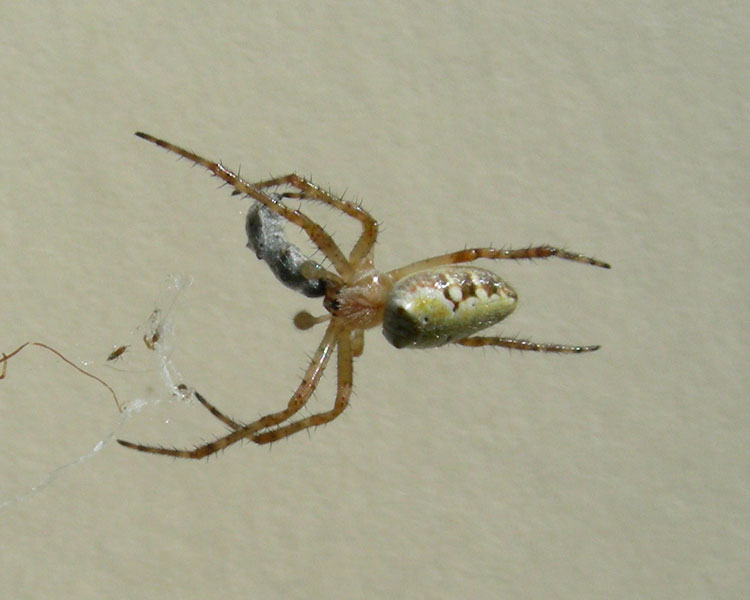 This male Argiope spun his orb web over a fan flower Scaevola aemula. Judging by the number of flies and other insects visiting while I took photos, he's going to be eating like a king until the flowers finish blooming or a bird snatches him—whichever comes first.


Monday, 30 October 2006
Grauniad back to old form
Author Jim Crace has a piece in Guardian Books about a fictitious book, Useless America, that Amazon credits him with writing. The booksellers have taken a typo and built it into a hardback edition and a paperback (to be released in September 2007).
It's a great article and makes you wonder whether it's worth struggling with a 100,000 word manuscript when you can get decent sales on a non-existent work.
But Guardian Books (bless 'em) have mistaken Jim Crace for John Crace, who writes the delicious Digested Reads. Their front page actually reads:
Of course, they might have fixed it by now. But trust me. That's what it said.
You can get a taste of John Crace's work in this earlier post on A Snail's Eye View.
A new kind of ghost writer>
Amazon has invented a book and sold it as mine. Perhaps this is the future of publishing
Jim Crace
Saturday October 28, 2006
It's a great article and makes you wonder whether it's worth struggling with a 100,000 word manuscript when you can get decent sales on a non-existent work.
But Guardian Books (bless 'em) have mistaken Jim Crace for John Crace, who writes the delicious Digested Reads. Their front page actually reads:
A new kind of ghost writer
John Crace: Amazon has invented a book and sold it as mine. Is this the future of publishing.
Of course, they might have fixed it by now. But trust me. That's what it said.
You can get a taste of John Crace's work in this earlier post on A Snail's Eye View.
A Hallowe'en treat
Welsh Incident
Robert Graves
'But that was nothing to what things came out
From the sea-caves of Criccieth yonder.'
'What were they? Mermaids? dragons? ghosts?'
'Nothing at all of any things like that.'
'What were they, then?'
Very strange, un-Welsh, utterly peculiar
Things. Oh, solid enough they seemed to touch,
Had anyone dared it. Marvellous creation,
All various shapes and sizes, and no sizes,
All new, each perfectly unlike his neighbour,
Though all came moving slowly out together.'
'Describe just one of them.'
Or perhaps more like crimson, but not purplish.
Some had no colour.'
'But did these things come out in any order?'
What o'clock was it? What was the day of the week?
Who else was present? How was the weather?'
'I was coming to that. It was half-past three
On Easter Tuesday last. The sun was shining.
The Harlech Silver Band played Marchog Jesu
On thirty-seven shimmering instruments
Collecting for Caernarvon's (Fever) Hospital Fund.
The populations of Pwllheli, Criccieth,
Portmadoc, Borth, Tremadoc, Penrhyndeudraeth,
Were all assembled. Criccieth's mayor addressed them
First in good Welsh and then in fluent English,
Twisting his fingers in his chain of office,
Welcoming the things. They came out on the sand,
Not keeping time to the band, moving seaward
Silently at a snail's pace. But at last
The most odd, indescribable thing of all
Which hardly one man there could see for wonder
Did something recognizably a something.'
'Well, what?'
Like groaning to oneself on Sunday morning
In Chapel, close before the second psalm.'
'What did the mayor do?'
Robert Graves
'But that was nothing to what things came out
From the sea-caves of Criccieth yonder.'
'What were they? Mermaids? dragons? ghosts?'
'Nothing at all of any things like that.'
'What were they, then?'
'All sorts of queer things,
Things never seen or heard or written about,Very strange, un-Welsh, utterly peculiar
Things. Oh, solid enough they seemed to touch,
Had anyone dared it. Marvellous creation,
All various shapes and sizes, and no sizes,
All new, each perfectly unlike his neighbour,
Though all came moving slowly out together.'
'Describe just one of them.'
'I am unable.
'What were their colours?''Mostly nameless colours,
Colours you'd like to see; but one was puceOr perhaps more like crimson, but not purplish.
Some had no colour.'
'Tell me, had they legs?'
'Not a leg or foot among them that I saw.''But did these things come out in any order?'
What o'clock was it? What was the day of the week?
Who else was present? How was the weather?'
'I was coming to that. It was half-past three
On Easter Tuesday last. The sun was shining.
The Harlech Silver Band played Marchog Jesu
On thirty-seven shimmering instruments
Collecting for Caernarvon's (Fever) Hospital Fund.
The populations of Pwllheli, Criccieth,
Portmadoc, Borth, Tremadoc, Penrhyndeudraeth,
Were all assembled. Criccieth's mayor addressed them
First in good Welsh and then in fluent English,
Twisting his fingers in his chain of office,
Welcoming the things. They came out on the sand,
Not keeping time to the band, moving seaward
Silently at a snail's pace. But at last
The most odd, indescribable thing of all
Which hardly one man there could see for wonder
Did something recognizably a something.'
'Well, what?'
'It made a noise.'
'A frightening noise?'
'No, no.''A musical noise? A noise of scuffling?'
'No, but a very loud, respectable noise ---Like groaning to oneself on Sunday morning
In Chapel, close before the second psalm.'
'What did the mayor do?'
'I was coming to that.'
Painted lady
 To stop this turning into a bird blog, here's another winged creature that's just as pretty but lacks a backbone—an Australian painted lady (Vanessa kershawi).
Species of painted ladies and the closely-related admirals (now there's the start of a music hall joke) are found worldwide. The Australian painted lady occurs in Australia and New Zealand. Specimens have even been recorded on Macquarie Island. It is partially migratory, moving south in early spring. Rather fewer individuals make the return flight north in autumn.
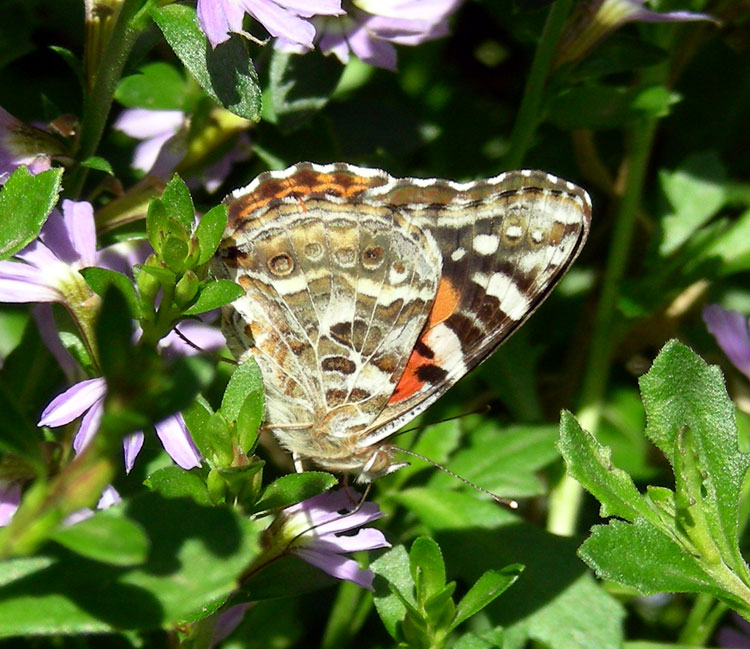 Caterpillars feed on a range of Asteraceae, including native Bracteantha and Leucochrysum, but their predilection for introduced species, especially Cape weed (Arctotheca and Scotch thistle (Onopordom), has allowed them to multiply. Museum Victoria's Bioinformatics database suggests that the species has increased in frequency over the past three decades.
This species has been mistaken for the more widely-distributed painted lady (V. cardui) and has been shifted in and out of synonymy with it. Vanessa cardui does occur in Australia but is now known to be restricted to the Perth – Bunbury region of the south-west. The WA population may have originated in Africa and become established in Australia following long-distance dispersal across the Indian Ocean. Like the Australian species, its caterpillars feed on a large range of host plants, so there will always be something for them to snack on.
Why a duck? Er ... goose?
How do you tell the difference between a goose, a duck and a swan? No, it’s not a joke, although one is forming in my mind as I type.
Let’s see. We could line ‘em up in order of size. Ducks are small, swans are big and geese are somewhere in the middle.
Or by plumage. Ducks are colourful, swans are white—or black or black and white—and geese are somewhere in the middle.
 Hmmm. I thought I could see a pattern. But when I checked the most recent studies on the Anseriformes* (the group to which they all belong), the story wasn’t quite that simple. Ducks? Tick. Swans? Tick. Geese? Well, it seems that they’re what’s left over when the ducks and swans are taken out.
There are true geese, which belong to genera Anser and Branta. No one has a problem with those. There are true swans—Cygnus and their close relative Coscoroba of South America. And there are a dozen or so genera of true ducks. But that still leaves a bunch of others floating about without a neat … er … pigeon hole to roost in.
 Among the orphans are the shelducks and sheldgeese. This group has long been recognised as an anomalous one, with features characteristic of both ducks and geese but fitting in with neither. Apart from the widespread Tadorna shelducks, the group includes Chloephaga sheldgeese from South America, African Alopochen 'geese' and others.
One classification treats the group as belonging with true ducks. Another puts it with the geese and swans. A third leaves it out on its own ...
Whistling-ducks (Dendrocygnus) are another enigmatic group. Although they are colourful birds that look a lot like ducks and walk a bit like ducks they just aren't ducky enough. Nor are they geese. Nor, despite the scientific name, are they tree-dwelling swans. Whistling-ducks are more or less out on their own in a lineage that diverged early on from the rest of the Anseriformes.
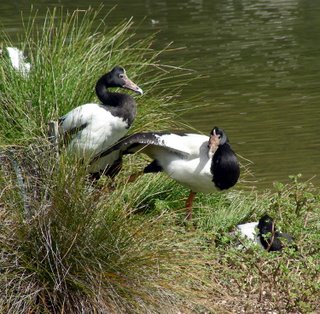 The magpie goose (Anseranas sempalmata) is another oddity. When Latham described it in 1798, he placed it in Anas, which at that time was a grab-bag for ducks. Lesson looked at it more critically and decided it was sufficiently different from other wildfowl to have its own genus. But he had a bet each way with Anseranas—Anser points towards goose and Anas towards duck.
In fact, it is closely related to neither. The magpie goose is descended from a lineage even older than that of whistling-ducks. Only one group of Anseriformes has a more ancient history—the South American screamers (Anhima, Chauna). (One classification places these spur-winged, webless water birds as sister group to the magpie goose.)
 But there must be some Australian geese that really are geese in the Anser – Branta sense. Surely?
There's one. The Cape Barren goose (Cereopsis novaehollandiae of southern Australia is goose-ish. It doesn't snuggle up tightly with the true geese but it swans around with the right crowd.
Just don't ask about the pygmy geese ...
_____________
* Which means 'goose-like'. Told you it was confusing.
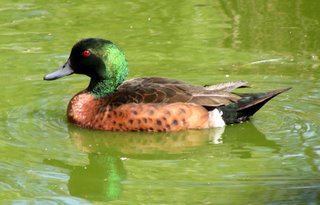
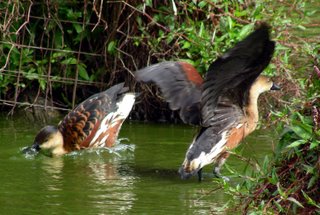
From top: Chestnut teal (Anas castanea); Wandering whistling-duck (Dendrocygna arcuata); Magpie goose (Anseranas semipalmata); Cape Barren goose (Cereopsis novaehollandiae)
Read more
Donne-Goussé, C., Laudet, V. & Hänni, C. (2002). A molecular phylogeny of Anseriformes based on mitochondrial DNA analysis. Molecular Phylogenetics and Evolution 23: 339–356.
Let’s see. We could line ‘em up in order of size. Ducks are small, swans are big and geese are somewhere in the middle.
Or by plumage. Ducks are colourful, swans are white—or black or black and white—and geese are somewhere in the middle.
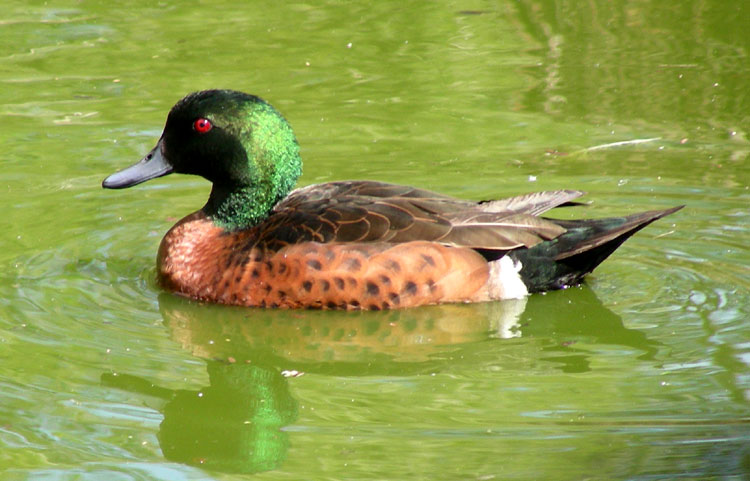 Hmmm. I thought I could see a pattern. But when I checked the most recent studies on the Anseriformes* (the group to which they all belong), the story wasn’t quite that simple. Ducks? Tick. Swans? Tick. Geese? Well, it seems that they’re what’s left over when the ducks and swans are taken out.
There are true geese, which belong to genera Anser and Branta. No one has a problem with those. There are true swans—Cygnus and their close relative Coscoroba of South America. And there are a dozen or so genera of true ducks. But that still leaves a bunch of others floating about without a neat … er … pigeon hole to roost in.
 Among the orphans are the shelducks and sheldgeese. This group has long been recognised as an anomalous one, with features characteristic of both ducks and geese but fitting in with neither. Apart from the widespread Tadorna shelducks, the group includes Chloephaga sheldgeese from South America, African Alopochen 'geese' and others.
One classification treats the group as belonging with true ducks. Another puts it with the geese and swans. A third leaves it out on its own ...
Whistling-ducks (Dendrocygnus) are another enigmatic group. Although they are colourful birds that look a lot like ducks and walk a bit like ducks they just aren't ducky enough. Nor are they geese. Nor, despite the scientific name, are they tree-dwelling swans. Whistling-ducks are more or less out on their own in a lineage that diverged early on from the rest of the Anseriformes.
 The magpie goose (Anseranas sempalmata) is another oddity. When Latham described it in 1798, he placed it in Anas, which at that time was a grab-bag for ducks. Lesson looked at it more critically and decided it was sufficiently different from other wildfowl to have its own genus. But he had a bet each way with Anseranas—Anser points towards goose and Anas towards duck.
In fact, it is closely related to neither. The magpie goose is descended from a lineage even older than that of whistling-ducks. Only one group of Anseriformes has a more ancient history—the South American screamers (Anhima, Chauna). (One classification places these spur-winged, webless water birds as sister group to the magpie goose.)
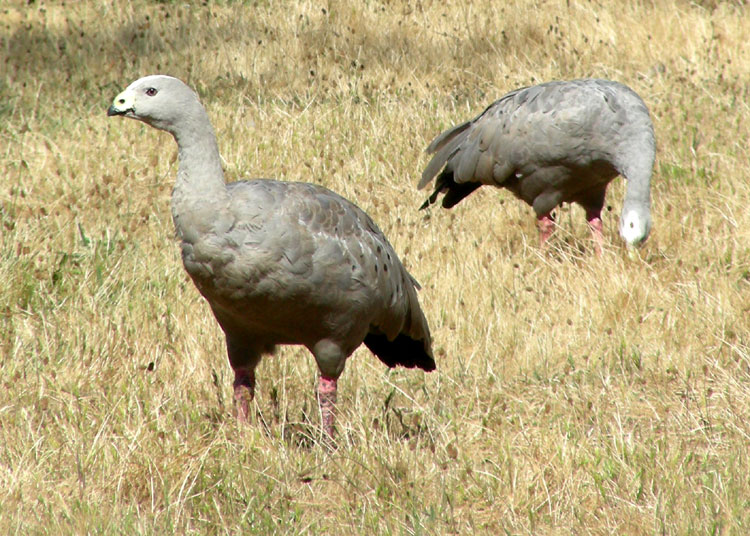 But there must be some Australian geese that really are geese in the Anser – Branta sense. Surely?
There's one. The Cape Barren goose (Cereopsis novaehollandiae of southern Australia is goose-ish. It doesn't snuggle up tightly with the true geese but it swans around with the right crowd.
Just don't ask about the pygmy geese ...
_____________
* Which means 'goose-like'. Told you it was confusing.
From top: Chestnut teal (Anas castanea); Wandering whistling-duck (Dendrocygna arcuata); Magpie goose (Anseranas semipalmata); Cape Barren goose (Cereopsis novaehollandiae)
Read more
Donne-Goussé, C., Laudet, V. & Hänni, C. (2002). A molecular phylogeny of Anseriformes based on mitochondrial DNA analysis. Molecular Phylogenetics and Evolution 23: 339–356.
Sunday, 29 October 2006
Backson
Sorry. Limited blogging today. Spent most of the afternoon* trying to expunge a virus from the computer. I think I've finally managed to kick it out. (That's what happens when you try to renew your expired Symantec registration. I gave up and went for Avast! instead. Aaarrrr!.
So having spent so much time mucking around, I'd better do as much as I can of my 500 – 1000 word quota before contributing to the blog. Them what writes knows what I mean.
______
*I should have sorted it out this morning. But daylight saving came in today and there wasn't much of a morning. Not when I got out of bed at an appallingly late hour.
So having spent so much time mucking around, I'd better do as much as I can of my 500 – 1000 word quota before contributing to the blog. Them what writes knows what I mean.
______
*I should have sorted it out this morning. But daylight saving came in today and there wasn't much of a morning. Not when I got out of bed at an appallingly late hour.
Six word story? No problem. See?
WIRED magazine asked SF, fantasy and horror authors, film directors, scriptwriters and game designers to write a story in six words. Here's a selection. You can read the complete list here.
Leia: "Baby's yours." Luke: "Bad news…"
Steven Meretzky
whorl. Help! I'm caught in a time
Darren Aronofsky and Ari Handel
WORLD'S END. Sic transit gloria Monday.
Gregory Benford
The baby’s blood type? Human, mostly.
Orson Scott Card
Longed for him. Got him. Shit.
Margaret Atwood
Leia: "Baby's yours." Luke: "Bad news…"
Steven Meretzky
whorl. Help! I'm caught in a time
Darren Aronofsky and Ari Handel
WORLD'S END. Sic transit gloria Monday.
Gregory Benford
The baby’s blood type? Human, mostly.
Orson Scott Card
Longed for him. Got him. Shit.
Margaret Atwood
Saturday, 28 October 2006
Flies time
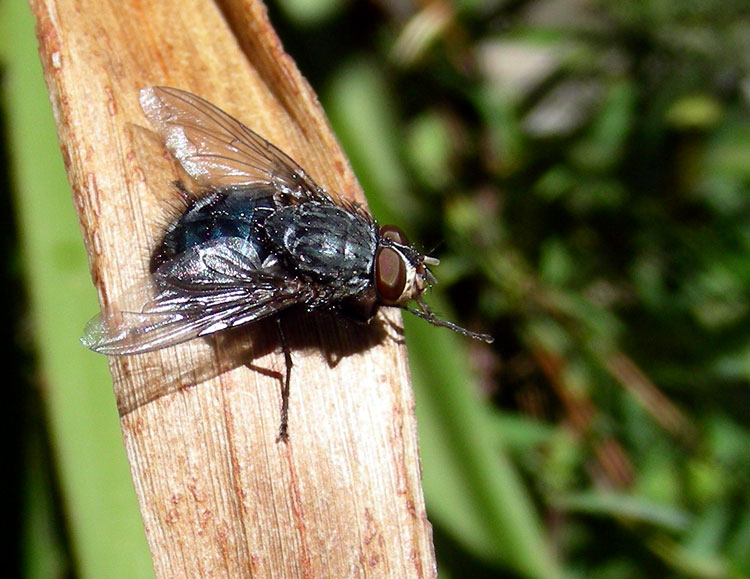 As late spring settles down into early summer, nature perks up. Flies get friskier. It'll only be a short time before the buzzing blizzards descend on the barbecue.
 Archdeacon William Paley—who introduced the watchmaker analogy to describe the work of a creator—believed he saw evidence of divine intervention in the flight of flies. In his 1802 treatise Natural Theology, he wrote:
In a spring noon, or a summer evening, on whichever side I turn my eyes, myriads of happy beings crowd upon my view. "The insect youth are on the wing." Swarms of newborn flies are trying their pinions in the air. Their sportive motions, their wanton mazes, their gratuitous activity, their continual change of place without use or purpose, testify their joy, and the exultation which they feel in their lately discovered faculties.
He imagined the flies dancing with delight in celebration of their creator. Had Paley spent less time in fly-free church and more at fly-ridden barbecues, he might have arrived at a different conclusion.
The reference to 'insect youth' comes from Thomas Gray's Ode to the Spring.
The insect youth are on the wing,
Eager to taste the honied spring,
And float amid the liquid noon:
Some lightly o'er the current skim,
Some show their gaily-gilded trim
Quick-glancing to the sun.
 Gray sounds like another man who didn't eat many charred snags amid clouds of blowies.
 He was probably talking about newly-emerged mayflies skimming 'lightly o'er the current'. But I'd like to think that he had this calliphorid in mind when he described some flies with 'their gaily-gilded trim.' Look at that little buzzer shine!
Road trip
That's done it. The madeleine effect of the flowering Mount Blackwood holly has left me yearning for a road trip. I can't blame the plant entirely. I made the mistake of listening to Jimmy Barnes' Driving Wheels while I was typing up the previous post. Now there's a song for a road trip.
The holly and the memory
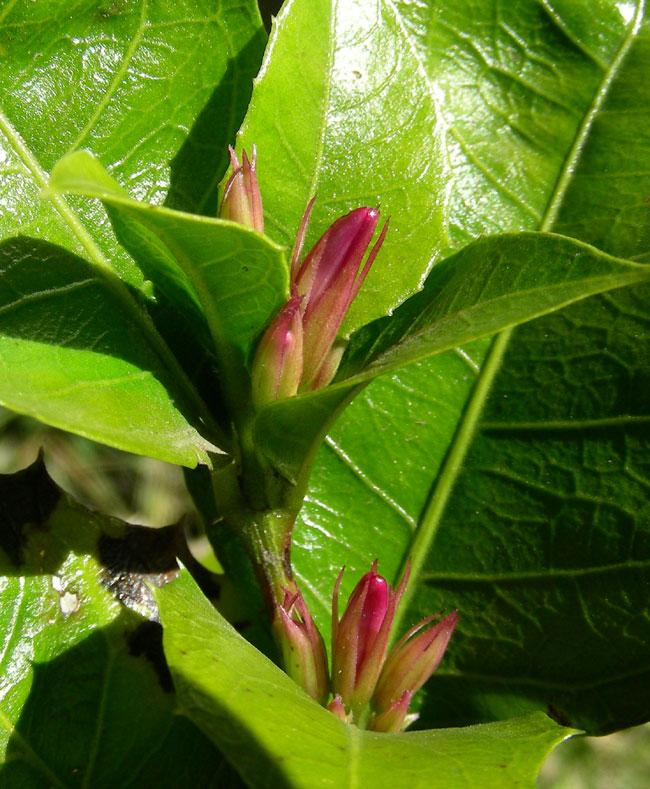 Duncan at Ben Cruachan reminded me of how plants can be living memories. They connect us with times and places and sometimes with people. One of my garden plants, the Mount Blackwood holly* (Graptophyllum ilicifolium) is about to come into flower. When I saw the buds this morning ...
I lived in North Queensland for eleven years. I had study sites along the more accessible parts of the tropical coast from Cooktown in the north to Sarina, just south of Mackay. I tried to visit each spot as many times as possible in both the wet and dry seasons. One of my sites was Mount Blackwood in mid-east Queensland.
The drive south from Townsville is not exciting. The Bruce Highway passes through cattle paddocks and cane fields, with only a few isolated hills and the odd waterway to interrupt the monotony. (Admittedly, one of those waterways is the Burdekin River. Cross that in flood and you won't forget the sight.) But once you get to the Proserpine region, the Clarke Range livens up the landscape. But that rises on the western side of the road. The east is broken by occasional peaks, one of which is Mount Blackwood.
 Graptophyllum ilicifolium grows on Mount Blackwood and neighbouring Mount Jukes between Cape Hillsborough and the tiny community of Kuttabul. Although the rainforest that covers them was probably once continuous with the montane rainforests of Eungella to the west, they have now been isolated by agriculture. They're islands of biodiversity in a sea of monocultures.
My trips to that part of the world bypassed Mackay, the only large town in the area, and concentrated on three spots: Mount Blackwood, Cape Hillsborough and Eungella. That trio of locations covered rainforests of all types and a host of endemic species, including invertebrates (of course) and frogs as well as the Eungella honeyeater (Lichenostomus hindwoodi). On one of my trips, we turned up a rare and somewhat obscure narrow-range endemic arachnid that's now named after me. When I say 'we', what I mean is that I was in the vicinity. To tell the truth, I was sitting in the car complaining about the rain and the leeches while the apparently water-proof arachnologist sifted through mounds of sodden leaf litter to collect a single specimen. It was hot chocolates all round that evening, I can tell you.
Now where did I leave my car keys? Come on. It's only a three-day drive.
_________
*It's not a holly but has holly-like leaves.
Friday, 27 October 2006
Face off
If you've ever wanted to know what you look like on the other side of your face, this exhibit at the Mütter Museum of the College of Physicians of Philadelphia will satisfy your curiosity. You'll need QuickTime to rotate the image.
It's not nearly as gruesome as it sounds.
It's not nearly as gruesome as it sounds.
TGIEOS
End of semester
O frabjous day! Calloo! Callay!
The marking is under control. (Not actually finished, you understand, but penned up in the corner where it can't do any harm.) From now on, I should have enough spare time to get back into serious blogging. By 'from now on', I mean tomorrow. Tonight I'm going to stretch out on the sofa with a stack of books, some of which I may get as far as opening before I doze off.
Wish me luck.
O frabjous day! Calloo! Callay!
The marking is under control. (Not actually finished, you understand, but penned up in the corner where it can't do any harm.) From now on, I should have enough spare time to get back into serious blogging. By 'from now on', I mean tomorrow. Tonight I'm going to stretch out on the sofa with a stack of books, some of which I may get as far as opening before I doze off.
Wish me luck.
Thursday, 26 October 2006
Bird round up at Snail's Eye View
What you can see and where you can see 'em:
Brush-turkey (Alectura lathami)
Magpie goose (Anseranas semipalmata)
Plumed whistling duck (Dendrocygna eytonii)
Wood or maned duck (Chenonetta jubata)
Australasian grebe (Tachybaptus novaehollandiae) and another one
Little black cormorant (Phalacrocorax sulcirostris)
White-necked heron (Ardea pacifica)
Whistling kite (Haliastur sphenurus)
Australian bustard (Ardeotis australis)
Bush stone-curlew (Burhinus grallacus)
Silver gull (Larus novaehollandiae)
Crested tern (Sterna bergii)
Macleay's honeyeater (Xanthotis macleayana)
Lewin's honeyeater (Meliphaga lewinii)
New Holland honeyeater (Philidonyris novaehollandiae)
Blue-faced honeyeater (Entomyzon cyanotis)
Grey-headed robin (Heteromyias albispecularis)
Black butcherbird (Cracticus quoyi))
Male and female Victoria's riflebird (Ptiloris victoriae)
Spotted catbird (Ailuroedus melanotis)
Tooth-billed bowerbird (Scenopoeetes dentirostris)
Mistletoebird (Dicaeum hirudinaceum)
Brush-turkey (Alectura lathami)
Magpie goose (Anseranas semipalmata)
Plumed whistling duck (Dendrocygna eytonii)
Wood or maned duck (Chenonetta jubata)
Australasian grebe (Tachybaptus novaehollandiae) and another one
Little black cormorant (Phalacrocorax sulcirostris)
White-necked heron (Ardea pacifica)
Whistling kite (Haliastur sphenurus)
Australian bustard (Ardeotis australis)
Bush stone-curlew (Burhinus grallacus)
Silver gull (Larus novaehollandiae)
Crested tern (Sterna bergii)
Macleay's honeyeater (Xanthotis macleayana)
Lewin's honeyeater (Meliphaga lewinii)
New Holland honeyeater (Philidonyris novaehollandiae)
Blue-faced honeyeater (Entomyzon cyanotis)
Grey-headed robin (Heteromyias albispecularis)
Black butcherbird (Cracticus quoyi))
Male and female Victoria's riflebird (Ptiloris victoriae)
Spotted catbird (Ailuroedus melanotis)
Tooth-billed bowerbird (Scenopoeetes dentirostris)
Mistletoebird (Dicaeum hirudinaceum)
Hot off the press: I and the Bird #35
Bird blogs from around the world at I and the Bird #35. This month it's hosted by Migrations. Visit for the ornithology; stick around for the insights.
Just got in from work. No, really.
A much better day than yesterday. I caught up with friends for lunch. We talked about environmental policy and reminisced about the old days. That's what happens beyond a certain age. In the same way that every CD left in the car becomes the Best of Queen*, so every conversation steers towards How Things Used To Be.
Luckily, our nostalgia covered subjects such as the day someone left a gold nugget in the ladies loo at ... um ... an unnamed major museum. She was taking it to the safe but detoured on the way. After putting it down on the cistern, she then forgot about the nugget and went home. The next person to pop into the loo got a great surprise.
And on the subject of gold nuggets, we recalled the time when we arrived at work at the same unnamed major museum to find the geology department full of police. Some nincompoop had noticed the very large nugget on display in the window and decided to make off with it. He smashed the window, grabbed the booty (which was the best part of a foot long) and headed up the street. It wasn't until it slipped out of his grasp and shattered on the pavement that he realised his treasure was a plaster model coated in gold paint. To make matters worse for him, he'd put his hand flat against the upper window pane to smash the lower one, leaving a crystal clear print.
There were more stories, including several about the remains of a famous racehorse. But I can't tell you those. That would be giving away too much. They were good though. Take my word for it.
_______________
*According to Terry Pratchett and Neil Gaiman's book Good Omens.
A much better day than yesterday. I caught up with friends for lunch. We talked about environmental policy and reminisced about the old days. That's what happens beyond a certain age. In the same way that every CD left in the car becomes the Best of Queen*, so every conversation steers towards How Things Used To Be.
Luckily, our nostalgia covered subjects such as the day someone left a gold nugget in the ladies loo at ... um ... an unnamed major museum. She was taking it to the safe but detoured on the way. After putting it down on the cistern, she then forgot about the nugget and went home. The next person to pop into the loo got a great surprise.
And on the subject of gold nuggets, we recalled the time when we arrived at work at the same unnamed major museum to find the geology department full of police. Some nincompoop had noticed the very large nugget on display in the window and decided to make off with it. He smashed the window, grabbed the booty (which was the best part of a foot long) and headed up the street. It wasn't until it slipped out of his grasp and shattered on the pavement that he realised his treasure was a plaster model coated in gold paint. To make matters worse for him, he'd put his hand flat against the upper window pane to smash the lower one, leaving a crystal clear print.
There were more stories, including several about the remains of a famous racehorse. But I can't tell you those. That would be giving away too much. They were good though. Take my word for it.
_______________
*According to Terry Pratchett and Neil Gaiman's book Good Omens.
Wednesday, 25 October 2006
What they tortoise
 This long-necked tortoise looks rather less dubious from the front than it does from the side. This model shares a cubicle at Serendip Sanctuary with a white-faced heron and a frog. See, I'm not making it up.
 Apart from bird-watching from the wetland hides, which doesn't necessarily enthrall children, the sanctuary offers a pond area where they can dip nets into the water and examine the catch with dissecting microscopes and Holmesian magnifying glasses.
Luckily, I didn't have a net or I would have dragged it through the pond. With a small ibis rookery nearby, the water was bound to be seething with all sorts of greeblies. (Yes, it is a technical term.)
Tuesday, 24 October 2006
Essay, essay, essay
I'm staring at the first year essays and not getting very far with marking them. I thought I'd make more headway by keeping away from distractions, but—in best Lloyd Bridges style—I picked a bad day to stay at home. The rental house next door is being renovated. Cue hammer and drill. And council workers are digging up the pavement fifty metres along. Cue reversing trucks and concrete saw.
This morning I had breakfast at my favourite café, Gravy Train, on Gamon Street in Seddon. After a couple of flat whites and a smoked trout omelette, I felt much better. Then I heard that the owners have sold up. Zut alors! The staff are staying, though, which allayed my fears slightly. The news could have been worse. They might have sold Hausfrau, their bakery on Ballarat Street in Yarraville, as well.
I'd better get back to these essays. They're not going to mark themselves. Which is odd because some of them seem to have written themselves without human intervention.
This morning I had breakfast at my favourite café, Gravy Train, on Gamon Street in Seddon. After a couple of flat whites and a smoked trout omelette, I felt much better. Then I heard that the owners have sold up. Zut alors! The staff are staying, though, which allayed my fears slightly. The news could have been worse. They might have sold Hausfrau, their bakery on Ballarat Street in Yarraville, as well.
I'd better get back to these essays. They're not going to mark themselves. Which is odd because some of them seem to have written themselves without human intervention.
Monday, 23 October 2006
Bustard!
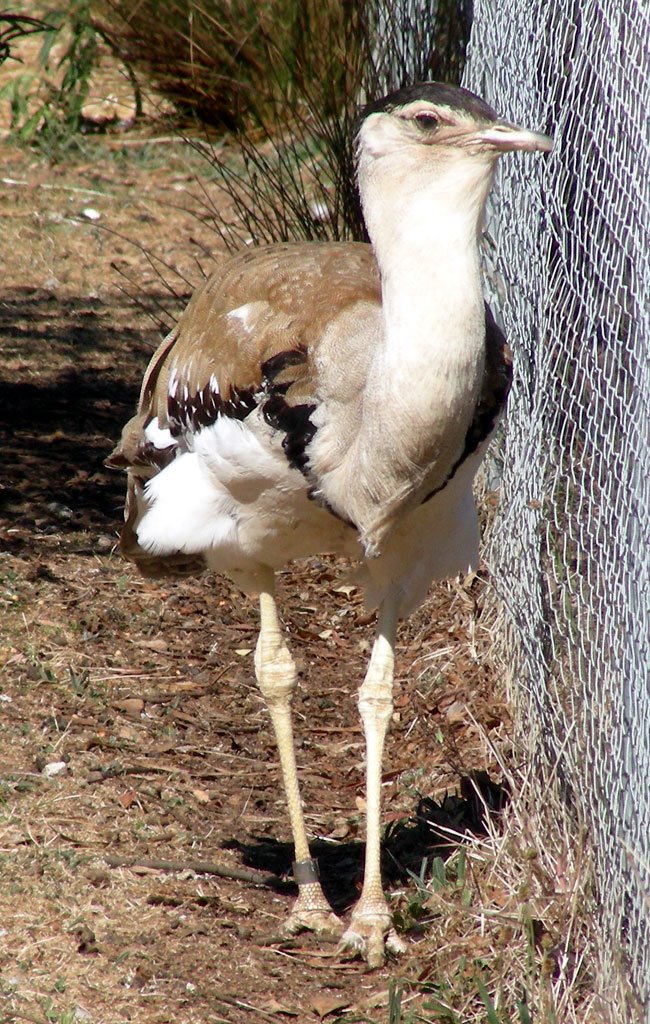 In his Field Guide to the Birds of Australia, Graham Pizzey described Australian bustards (Ardeotis australis) as 'lordly' and 'aloof.' And they are. They're big, unmistakeable birds that conduct themselves with the imperious manner of a baron inspecting his estate.
Once found across inland Australia, bustards are now rare to uncommon over most of their former range. I remember seeing a small flock roaming alongside the track through Fossilbrook, between Mount Garnet and Chillagoe in Far North Queensland. But that was 15 years ago. I'll be heading up that way again in July next year. I hope the population is still thriving. Elsewhere they have declined.
 It's been a long time since wild bustards occurred in any number down here in Victoria. But Serendip Sanctuary is breeding them for reintroduction into the west of the state. Whether that plan succeeds depends on removing the threats that caused them to decrease in the first place. What are the odds?
Warning: may contain traces of nuts
Some days I wonder why I bothered to get out of bed. I'm sure you're the same. (You wonder about yourself, that is. If you wondered about me, I'd be slightly disturbed.)
This morning I decided to have some of my homemade muesli for breakfast. Not a momentous decision, I think you'll agree. Not one that was likely to cause widespread havoc.
I took the container out of the pantry cupboard. As often happens, the contents had settled into strata. So I shook them up. But the lid wasn't on properly ...
Having wasted a portion of the morning sweeping up oats, slivered almonds and small cubes of sticky dried fruit, I thought it was about time I went to work. Apart from the odd nutter hurtling out of the hospital with a body in the back of the van*, the trip is usually uneventful. Not today. A nutter—who probably didn't have a dead body in the vehicle (it was a ute)—hurtled out of the hospital, causing the traffic to brake heavily.
I'd left plenty of room between my car and the one in front. No worries. But I'd forgotten about the collection of golf balls on the back seat. (That's another story.) Twenty-eight bright yellow balls followed the laws of momentum. It was like sitting in the middle of the Lotto machine.
By this time, the traffic had started moving again. I had nowhere to pull over. But there were more than two dozen golf balls rolling around in the foot well. What if they got stuck under the brake pedal? Now I was on a main road. Still no chance to pull over. All I could think of doing was using the newspaper, which was still in its plastic wrapper, to dam the flow. I slid The Age under the seat and held it in place with my left foot. Thank goodness for automatics.
So if you're hitchhiking and a 40-year-old woman in a dusty white Daewoo stops to give you a lift, you know what to say.
________
*Okay, it happened once.
This morning I decided to have some of my homemade muesli for breakfast. Not a momentous decision, I think you'll agree. Not one that was likely to cause widespread havoc.
I took the container out of the pantry cupboard. As often happens, the contents had settled into strata. So I shook them up. But the lid wasn't on properly ...
Having wasted a portion of the morning sweeping up oats, slivered almonds and small cubes of sticky dried fruit, I thought it was about time I went to work. Apart from the odd nutter hurtling out of the hospital with a body in the back of the van*, the trip is usually uneventful. Not today. A nutter—who probably didn't have a dead body in the vehicle (it was a ute)—hurtled out of the hospital, causing the traffic to brake heavily.
I'd left plenty of room between my car and the one in front. No worries. But I'd forgotten about the collection of golf balls on the back seat. (That's another story.) Twenty-eight bright yellow balls followed the laws of momentum. It was like sitting in the middle of the Lotto machine.
By this time, the traffic had started moving again. I had nowhere to pull over. But there were more than two dozen golf balls rolling around in the foot well. What if they got stuck under the brake pedal? Now I was on a main road. Still no chance to pull over. All I could think of doing was using the newspaper, which was still in its plastic wrapper, to dam the flow. I slid The Age under the seat and held it in place with my left foot. Thank goodness for automatics.
So if you're hitchhiking and a 40-year-old woman in a dusty white Daewoo stops to give you a lift, you know what to say.
________
*Okay, it happened once.
Sunday, 22 October 2006
Let us prey
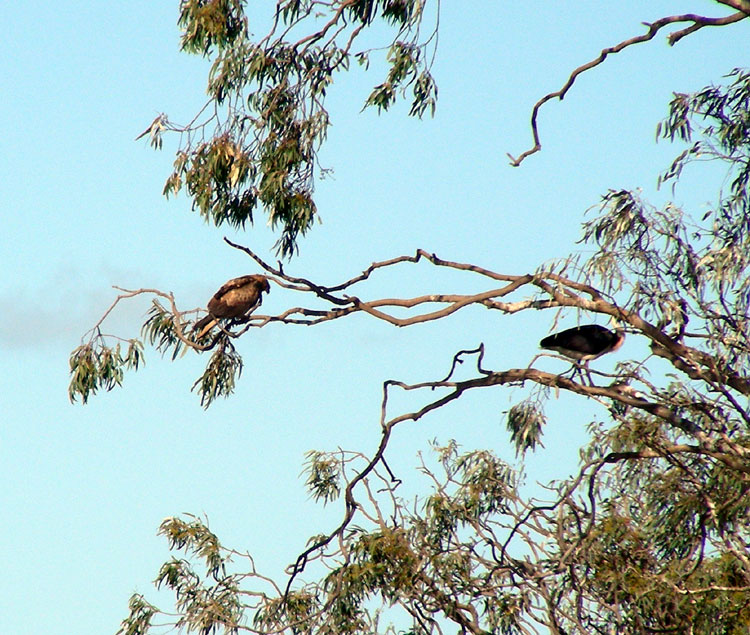 We were watching the white ibis organise their nests at the sanctuary when a lone straw-necked ibis joined them. It landed in the tree above the colony. As it was settling onto a suitable perch, another bird arrived at the afternoon rendezvous. This was obviously the place to be.
But it was unlikely that the second bird—a whistling kite—was there just to experience the friendly vibe. It was soon joined by another. They waited on the boughs closest to the colony. Maybe they were curious. Certainly, they were both watching the ibises on their nests.
 The pair got bored after a while and took off. They circled over the lake. Then one soared down to snatch a duckling. Fortunately (for the duckling, if not for the kite), it missed.
My camera batteries went flat seconds after I took these pictures. So I enjoyed the spectacle of five whistling kites and a squadron of pelicans gliding on thermals without experiencing the anxiety of trying to get them in focus.
[I'm pretty sure these are whistling kites. They were certainly whistling. From underneath the wings had dark tips and dark trailing edges. If I'd had spare batteries ...]
The curlew's call
From ferny streams, unearthly screams
Are heard in the midnight blue;
As afar they roam to the shepherd's home,
The shrieks of the wild Curlew!
The Song of the Curlew by Henry Kendall
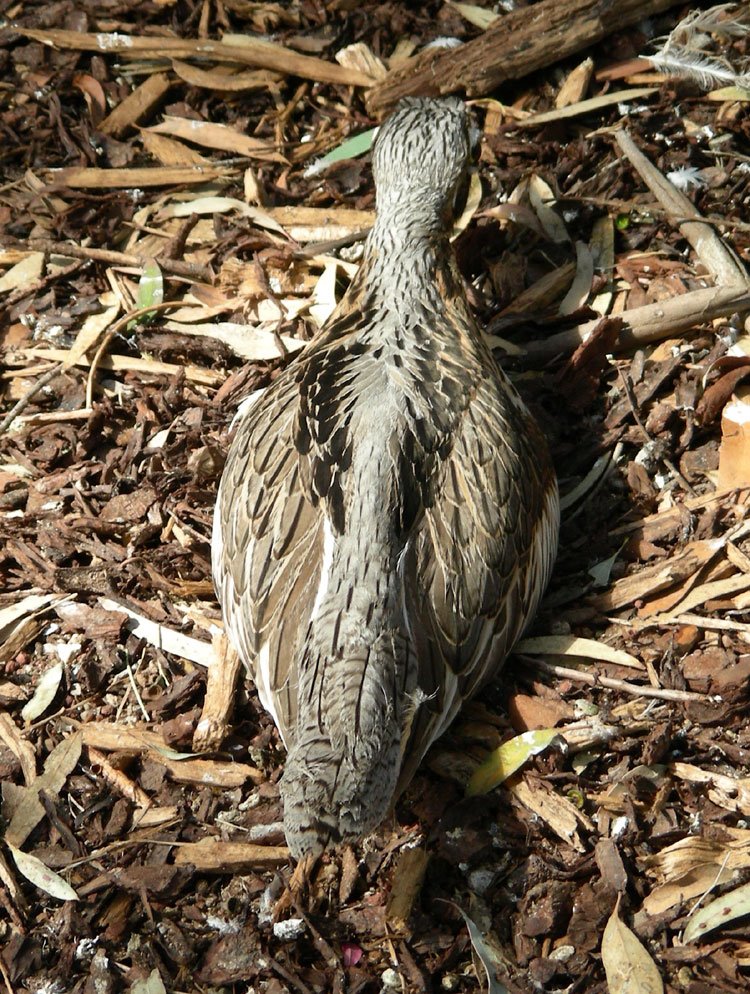 If you've spent any time in the north, you'll be familiar with this bird. You might not have seen one face to face but you'll certainly have heard its wailing call. Like the glorious carolling of the Australian magpie*, it is one of the definitive sounds of the bush.
The bush thick-knee or bush stone-curlew (Burhinus grallarius) used to be widespread but has decreased in some areas. Its decline is attributed to changes in land use but could also be due, in part, to birds being flattened by boots flung out of bedroom windows.
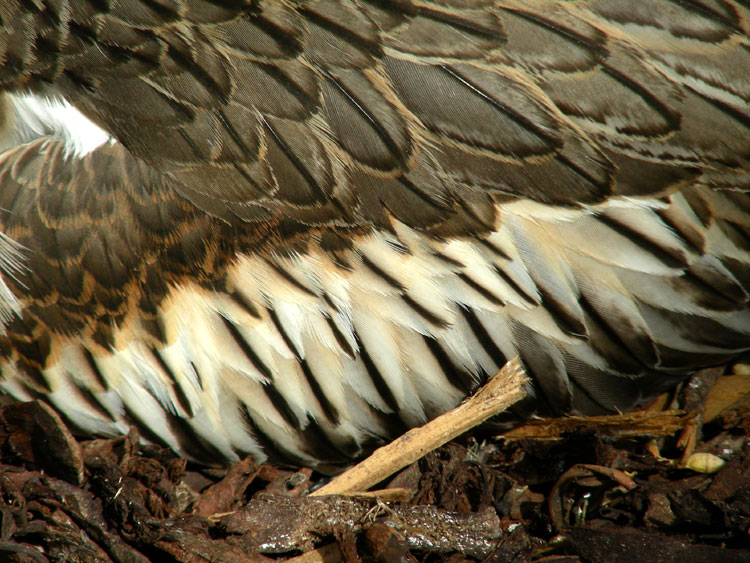 Bush thick-knees are nocturnal. They gather together on open ground (e.g. a garden) and call. One starts. The others join in. The maniacal wails increase in intensity until they reach a crescendo. Then they all stop. After a period of silence, they begin again.
I thought that they stopped suddenly because they became ashamed of their mass hysteria. They start again when they get over the embarrassment. But a friend suggested an alternative theory—they stop when they've woken everyone up. They them wait until everyone's dropped off to sleep and ...
Or they could just be communicating with each other, regardless of the humans carrying on around them. You never know.
 When you encounter one during the day, it will usually freeze and rely on its camouflage for protection. The cryptic coloration works well if the bird is resting on the ground. But if it's out and about, it is much more obvious. Those beautiful big yellow eyes give it away.
The best place to see them in the wild? Magnetic Island, near Townsville. But take ear plugs and move your boots to another room. It's a privilege to have the wildlife in such close proximity but your perspective tends to change at 3 a.m. ...
_____________
*Add your own favourite
[These photos are of a captive bird at Serendip Sanctuary]
Saturday, 21 October 2006
I salute our new ant overlords
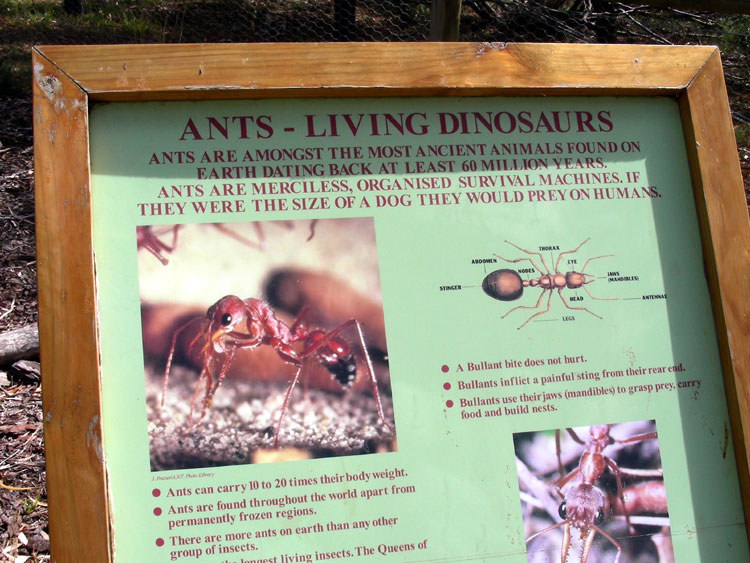 Serendip Sanctuary indulged in a smidgeon of hyperbole when they put together the copy for this interpretive sign. It's worth clicking on the photo to read the rest.
I'll have what they're having.
I see sawflies
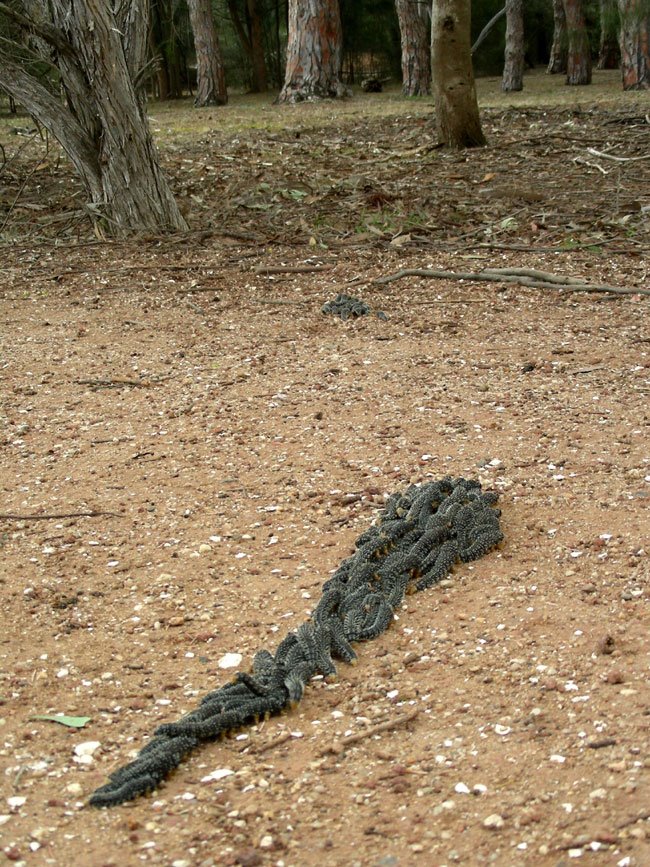 Now, not everybody goes gaga over a gang of sawfly larvae but I like them. They're odd little things, packed together into a mass, making their slow and determined way from one tree to another. This bunch were crossing the path at Serendip Sanctuary. I think most of them made it. When I passed the spot a couple of hours later only a couple of green smears indicated the death by boot of the unlucky few.
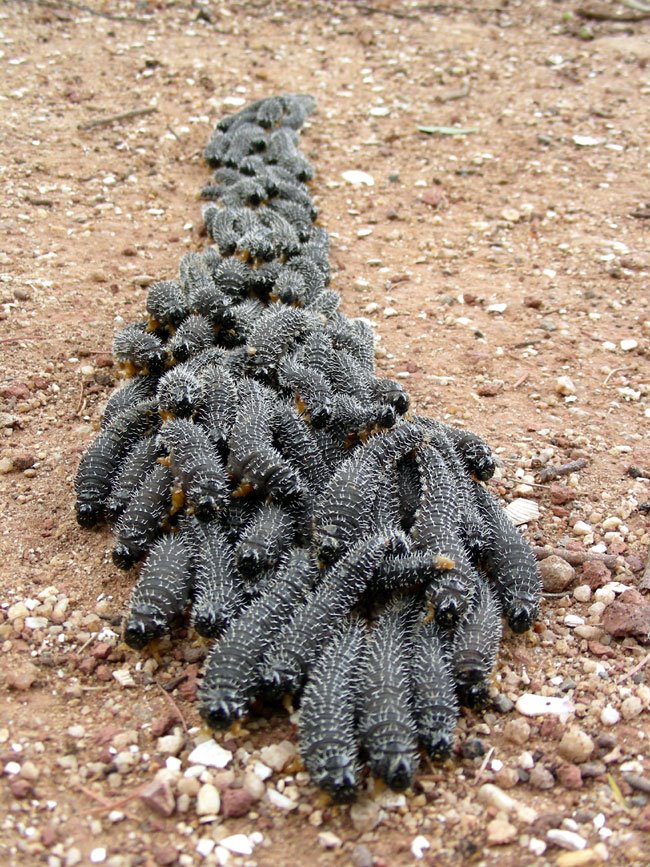 Sawflies are closely related to ants, wasps and bees, although you might not be able to spot the resemblance from the larvae. Adult females insert their eggs into leaf tissues. Once hatched, the larvae feed on eucalypts. So voracious are they that they sometimes defoliate host trees. When ready to pupate, they burrow into soil at the base of the tree trunk.
These sawflies are a species of Perga. They are known as spitfires because they regurgitate a glob of eucalyptus oil when annoyed. Very neat. Their food serves double duty as a source of nutrition and a weapon.
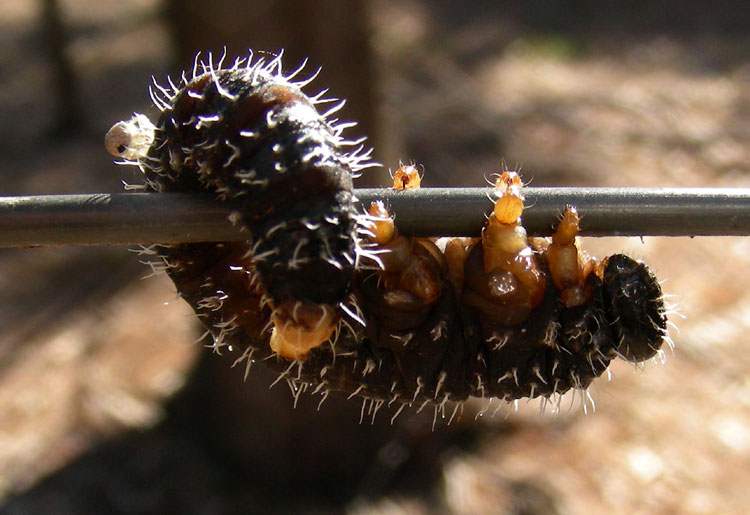 Of course, that will only get you so far. There's always something that will circumvent the best defences.
 I noticed this lone larva on a fence wire. It seemed like a very strange place for a spitfire to be. When I looked more closely, I saw something on its back. I'm not certain but I suspect it's a parasitoid on its way out.
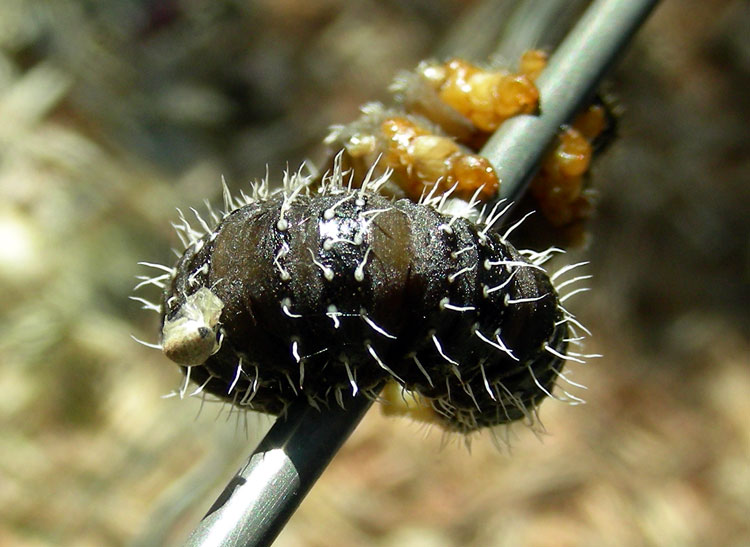 Parasitoids are animals that spend part of their lives inside (or occasionally on the surface) of another animal—the host. Unlike parasites, which don't deliberately kill their host, parasitoids will do so much damage that the host invariably dies. Many wasps are parasitoids. They lay their eggs inside a host insect, providing their larvae with a constant supply of fresh food. When the larvae are ready to emerge, they force their way out, leaving behind little more than the hollowed out exoskeleton of the host.
 But wait! There's more. Some species of wasps are hyperparasitoids, which lay their eggs inside the eggs of other parasitoids. There are even hyperhyperparasitoids ... Russian dolls of gruesomeness. You never know what you're going to uncover next.
[That it's a parasitoid is my best guess. If anybody's got a better idea of what's happening, please let me know.]
Morning in the You Yangs
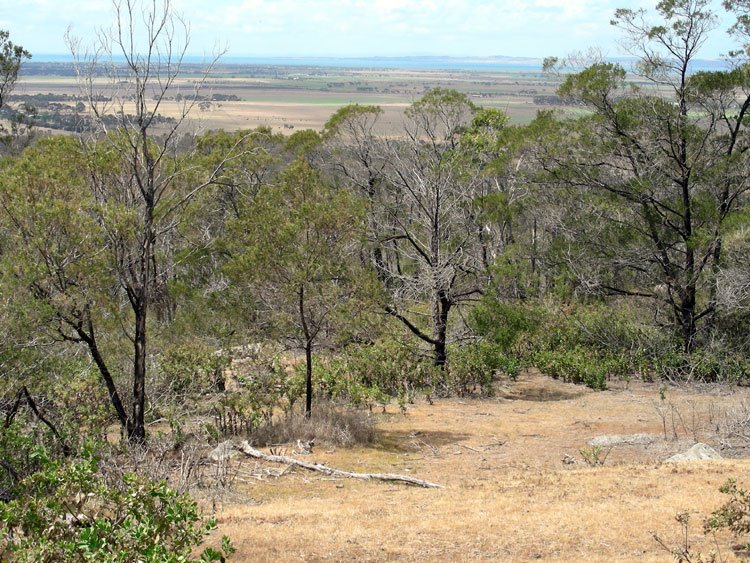 A friend and I spent the day at the You Yangs and Serendip Sanctuary. I just dropped her off at the airport and now I'm sorting through 240 photographs of our big day out. There would have been more but my camera batteries went flat. (Memo to self: carry a spare set, you idiot.) They went flat just as five (count 'em) whistling kites joined a bunch of pelicans soaring on a thermal over Serendip. They remained flat when one of the kites decided to grab a grey teal duckling from a sand bank. (It missed.) And when the only grebe of the day—a hoary-headed—disported itself with ungrebe-like candour on the lake right in front of me. But they managed to gather together enough residual charge to produce two images of a parasitised sawfly larva. Go figure.
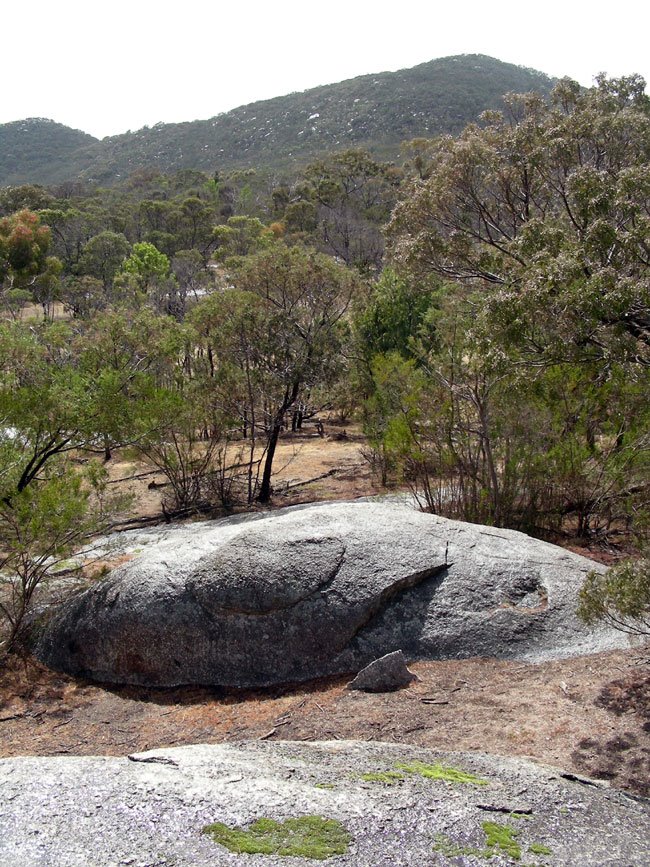 The You Yangs are about 55 km SW of Melbourne. The granite ridges rise 300 m and more above the basalt of the Werribee Plain. Although the surrounding landscape was sculpted by volcanic activity during the past 4 million years, the You Yangs were formed from a much older intrusion of magma into the overlying sedimentary rocks. Weathering eroded those rocks and exposed the granite. The hills are the most obvious geological feature between Melbourne and Geelong.
 Humans influence has been strong. The Yawangi balug ground out wells in the granite to improve the water supply. European settlers harvested timber and excavated gravel. Part of the park is timber plantation, the neat rows of gum trees devoid of understorey contrasting with the tangled and tatty natural bush.
We didn't climb Flinders Peak (which was scaled by Matthew Flinders on 1 May 1802). I would have, you know, if it hadn't been raining. (Oh, come on. Would I lie to you?) Instead, we did the Big Rock walk, which took us past a plantation, through woodland where the cherry ballart (Exocarpos) was producing fruit and onto a massive outcrop of granite. Big Rock, I suspect.
 We saw—but failed to identify—a whole bunch of small, twittering, hyperactive birds. One of us couldn't focus the binoculars, the other couldn't get the camera sorted out quickly enough. (They were probably silvereyes.) But that changed on the way back. We stopped next to a stately gum and the birds came to us. First a grey fantail. Then an eastern yellow robin. Then a New Holland honeyeater mum feeding its fluff-ball chicks. And finally a mistletoe bird. The latter was sitting about 2 m above my head, so I almost got a decent picture of it. But not quite. I have low standards to maintain.
Friday, 20 October 2006
Shell Wildlife Photographer of the Year
 What is this strange beast? It might look as if it comes from another planet but it's a walrus, grubbing up clams from the sea bed off Greenland. Goran Ehlme of Sweden won the title of Wildlife Photographer of the Year for this stunning portrait.
The BBC has an article about this and other award-winning photographs. An exhibition of the photographs opens tomorrow at the Natural History Museum in London. It will go on tour in May 2007.
Snail of the day
 I'll expand this post when I get a better picture of this handsome camaenid land snail from the Northern Territory. In the meantime, sit back from the monitor so you don't notice that it's not entirely in focus and imagine yourself on a beach in Arnhemland. (Evict any thoughts of crocodiles from your mind.)
 The shell is about 3 cm across, which makes it one of the larger land snails in that part of the world.
Tomorrow's schedule
Not much on the blog tonight but there should be a lot more over the weekend. I'm off to the You Yangs, Serendip Sanctuary and/or Werribee Mansion tomorrow. It's going to be cold and wet, so I'll have plenty of slightly blurred photos to share.
This warmed my deep-frozen academic heart. The excerpt below is from an article in the Guardian. The subject of the interview is musician, astronomer and author Brian May, whose PhD studies were halted by the success of his band, a four-piece combo called Queen.
May co-authored Bang! The Complete History of the Universe with Patrick Moore and Chris Lintott.
We are interrupted at this stage by a knock on the door and Paul Murdin, a professor of astronomy at Cambridge University and the treasurer of the RAS, walks in. He looks at May and blinks. May blinks back at him. The two men sit down and talk, with great passion and interest, about new developments in astronomy. They discuss the telescope in Tenerife, which when completed will be the biggest in the world. May has been invited to write and perform a piece of music for the grand opening.
"Yes," says Murdin, "of course the difficulty will be to write something that is inspiring without being sentimental."
May looks fleetingly glum. Then the professor asks him about his special interests.
"Zodiacal light."
Murdin blinks. Then he gives May the name of an eminent scholar in the US who might be willing to supervise the musician, should he wish to complete his PhD. ("Fortunately for me," May tells me, "zodiacal light has become kind of trendy again, because we're finding zodiacal clouds around other stars now, as you probably know.")
Tentatively, May says, "Would it be OK if I just emailed him, out of the blue?"
Even Murdin is cognisant of the modesty of this remark. "I think that would be fine," he says and from their different planets, the two men smile warmly at one another.
May co-authored Bang! The Complete History of the Universe with Patrick Moore and Chris Lintott.
Thursday, 19 October 2006
Dear diary
I'm going to bed early tonight because I'm dead tired. Which brings me onto today's anecdote ...
As I was driving to work this morning, some nitwit in a white Toyota Hiace van turned onto the road in front of me, causing me to brake heavily to avoid a collision.
I wasn't amused.
Normally, I would have sounded the horn in a firm but polite manner to indicate that something was amiss. But I didn't—largely because I was so surprised by the idiocy of the manoeuvre that I didn't think of it. Just as well.
The big white van had turned out of the hospital car park. When I had recovered from its sudden materialisation in front of me, I noticed that the rear window was blacked out. And on it was a stencilled logo ... advertising a local undertaker.
I hope the body was strapped in tightly.
As I was driving to work this morning, some nitwit in a white Toyota Hiace van turned onto the road in front of me, causing me to brake heavily to avoid a collision.
I wasn't amused.
Normally, I would have sounded the horn in a firm but polite manner to indicate that something was amiss. But I didn't—largely because I was so surprised by the idiocy of the manoeuvre that I didn't think of it. Just as well.
The big white van had turned out of the hospital car park. When I had recovered from its sudden materialisation in front of me, I noticed that the rear window was blacked out. And on it was a stencilled logo ... advertising a local undertaker.
I hope the body was strapped in tightly.
Wednesday, 18 October 2006
Heart of Darkness or One Woman in a Daewoo
Inspired by the ABC television series Two Men in a Tinnie, in which palaeontologist Tim Flannery and writer and comedian John Doyle travelled down Australia's longest river system, I thought I'd do something similar. Okay, there's only one of me, I don't have a boat and the nearest river is somewhat shorter than the Murray – Darling but that's not the point. After all, where would Burke and Wills have been were it not for that 'can do' spirit?
Well, you get my drift.
I could have emulated Flannery and Doyle by heading downstream from the river's source. But I thought I'd make my mark—I'd go upstream. So one woman in a Daewoo set out from the mouth of the Maribyrnong (actually, the Yarra a few hundred metres downstream of the confluence) to find the source.
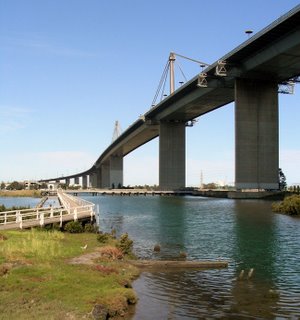 My Conradian journey started off at the West Gate Bridge, which is a landmark for so many reasons. On 15 October 1971, part of the bridge collapsed during construction, killing 35 workers. A Royal Commission attributed the disaster to a combination of poor design and non-standard building methods. The bridge was eventually finished in 1978. It spans the tidal mouth of the Yarra and sandy spit of Fisherman's Bend, connecting Geelong and the western suburbs to the CBD. It seemed like as good a place as any to begin.
The Maribyrnong meanders through Footscray and Flemington (past the race course) into Essendon. I took a more direct route, stopping off first at Edgewater, then the Boulevard.
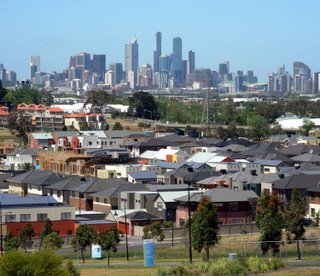 Although I live quite close to the housing development at Edgewater, I didn't have any idea of its magnitude. Today I decided to check it out. I almost started hyper- ventilating. It is so freaking big. Hundreds of housing plots spread along the edge of Gordon Street and down the bank and then spill over the flood plain. And the Maribyrnong has quite a substantial flood plain. How did I miss all this? Wilful ignorance, I suspect.
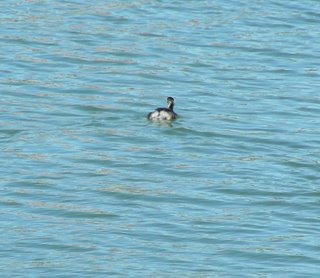
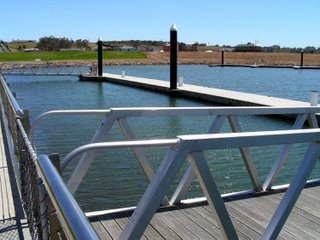 The river bank has been cleared of vegetation and remodelled into a small marina. I spent an hour looking around and saw a few black ducks on the far side of the river, a pied cormorant flapping overhead and the usual grebe. I also took the obligatory crap photo of the latter, which I think might be a hoary-headed grebe. (Although it could be a walrus, given my skills in bird identification.)
 Having survived the attack of the vapours brought on by Edgewater, I headed north to Essendon. Much more genteel. Still not entirely Conradian but who knows what strange excesses could be taking place behind the chintz?
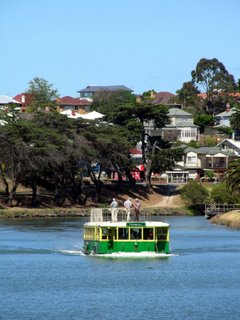 Despite the artificial neatness of the river banks, this stretch of the Maribyrnong is good for bird watching. Honeyeaters go crazy when the eucalypts are in flower and there's usually some sort of wildfowl around. On several occasions, I've seen up to fifty little black cormorants lined up on a power line across the river. They favour a perch near Poyton's Nursery. Most of them stare downstream, a few upstream. At these times, any fish that ventures too near the surface can say its piscine prayers as it disappears into one of a dozen black-feathered gullets.
I had to break off my journey into the heart of darkness then. I'll resume it at a later date. Stay tuned ...
Well, you get my drift.
I could have emulated Flannery and Doyle by heading downstream from the river's source. But I thought I'd make my mark—I'd go upstream. So one woman in a Daewoo set out from the mouth of the Maribyrnong (actually, the Yarra a few hundred metres downstream of the confluence) to find the source.
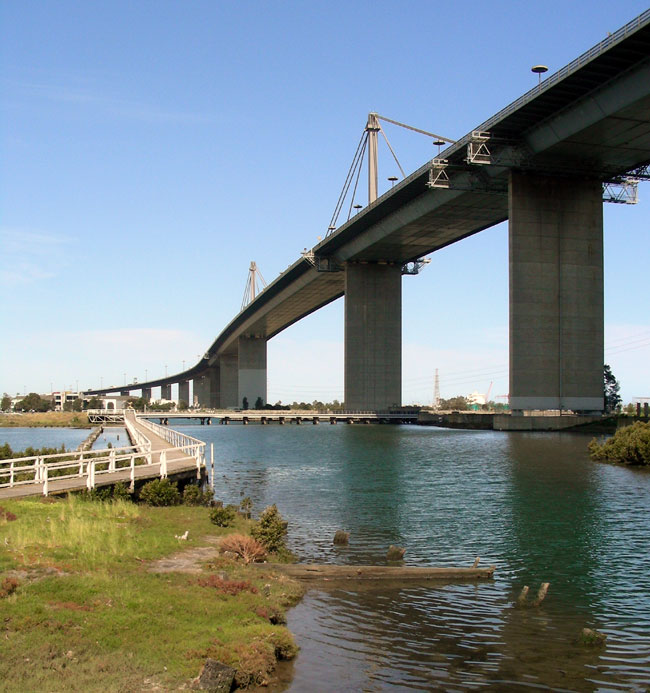 My Conradian journey started off at the West Gate Bridge, which is a landmark for so many reasons. On 15 October 1971, part of the bridge collapsed during construction, killing 35 workers. A Royal Commission attributed the disaster to a combination of poor design and non-standard building methods. The bridge was eventually finished in 1978. It spans the tidal mouth of the Yarra and sandy spit of Fisherman's Bend, connecting Geelong and the western suburbs to the CBD. It seemed like as good a place as any to begin.
The Maribyrnong meanders through Footscray and Flemington (past the race course) into Essendon. I took a more direct route, stopping off first at Edgewater, then the Boulevard.
 Although I live quite close to the housing development at Edgewater, I didn't have any idea of its magnitude. Today I decided to check it out. I almost started hyper- ventilating. It is so freaking big. Hundreds of housing plots spread along the edge of Gordon Street and down the bank and then spill over the flood plain. And the Maribyrnong has quite a substantial flood plain. How did I miss all this? Wilful ignorance, I suspect.
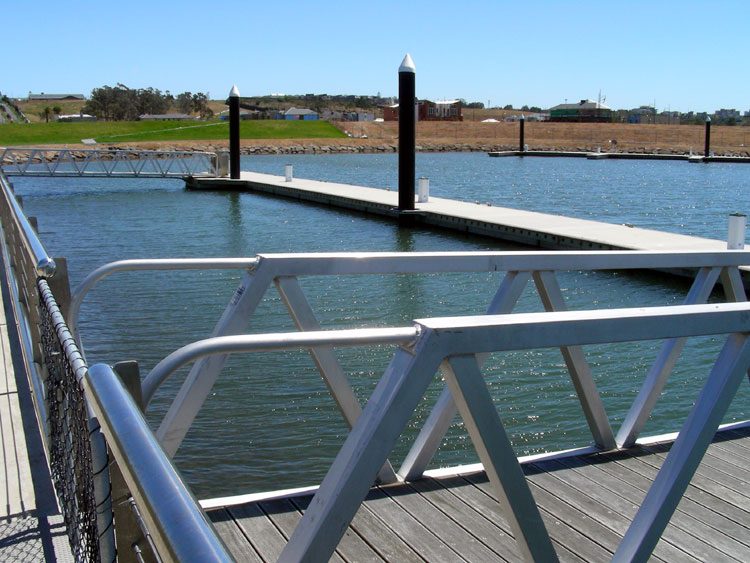 The river bank has been cleared of vegetation and remodelled into a small marina. I spent an hour looking around and saw a few black ducks on the far side of the river, a pied cormorant flapping overhead and the usual grebe. I also took the obligatory crap photo of the latter, which I think might be a hoary-headed grebe. (Although it could be a walrus, given my skills in bird identification.)
 Having survived the attack of the vapours brought on by Edgewater, I headed north to Essendon. Much more genteel. Still not entirely Conradian but who knows what strange excesses could be taking place behind the chintz?
 The horror! The horror!
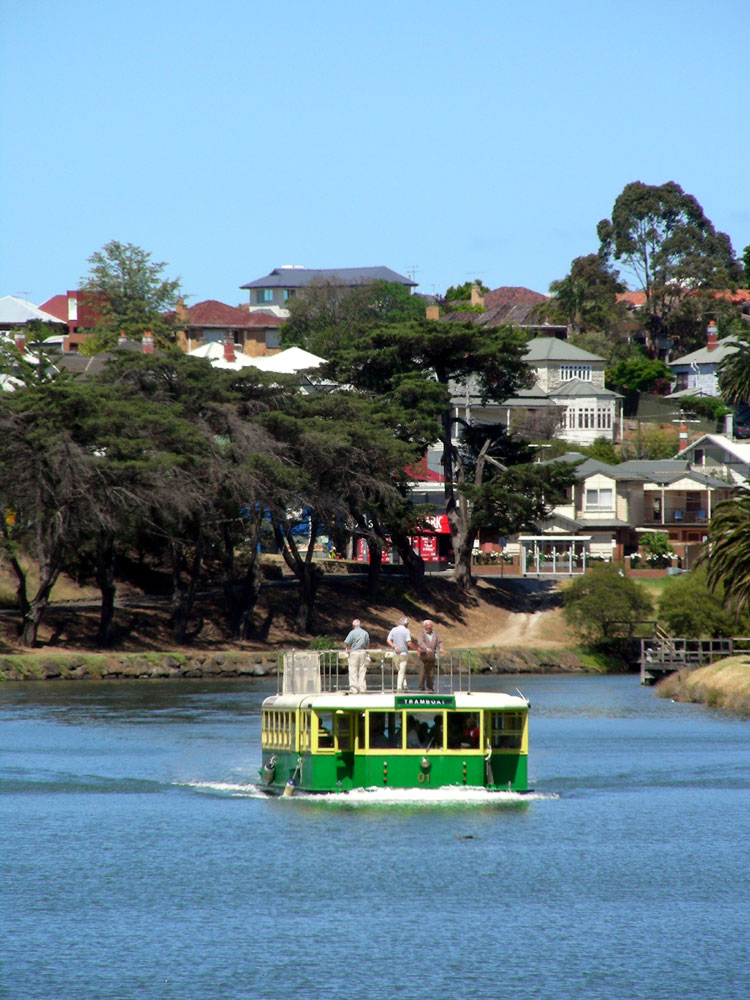 Despite the artificial neatness of the river banks, this stretch of the Maribyrnong is good for bird watching. Honeyeaters go crazy when the eucalypts are in flower and there's usually some sort of wildfowl around. On several occasions, I've seen up to fifty little black cormorants lined up on a power line across the river. They favour a perch near Poyton's Nursery. Most of them stare downstream, a few upstream. At these times, any fish that ventures too near the surface can say its piscine prayers as it disappears into one of a dozen black-feathered gullets.
I had to break off my journey into the heart of darkness then. I'll resume it at a later date. Stay tuned ...
Dapper ducks
As a child in London, I liked going to Victoria Park to look at the ducks. I wasn't so keen on feeding them but I enjoyed identifying the different species*. And there were many. Although, now I think about it, there might have only been mallard and tufted ducks but in my memory there were also widgeon and pochard and teal. Oh wait. I'm probably confusing it with the Wildfowl Trust at Slimbridge.
Anyway.
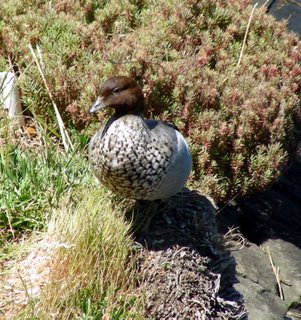 There's something about ducks. They always look as if they've just been dry-cleaned or polished and left out in the sun to dry. Even though they spend their days with their heads in muddy water and their bums in the air, they remain gleaming.
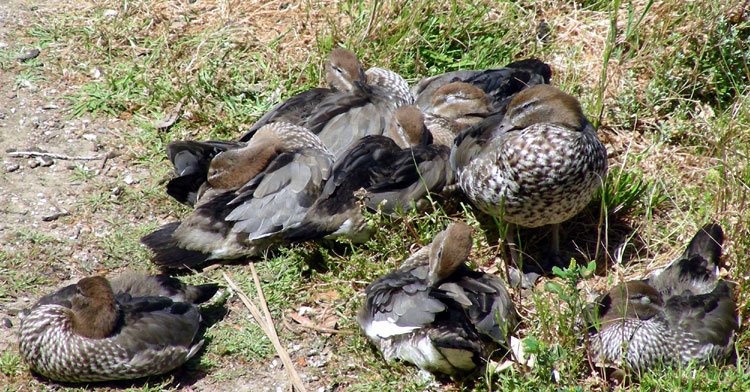
Despite their laconic charm, Australian ducks are every bit as glossy and neat as their northern counterparts. None more than wood ducks (Chenonetta jubata), which are not only glossy and neat but dapper as well.
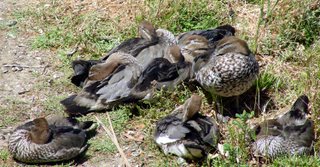 Wood ducks are also called maned ducks because the male sports a luxurious growth of long feathers on the nape of his neck. These birds are grazers, nipping at grass and other low vegetation with their small—but perfectly formed—beaks. They are more reticent toward humans than other ducks. Sensibly cautious. But this stand-offish behaviour is part of the wood duck package.
I photographed this group on the banks of the Maribyrnong River in Essendon. They were only pretending to be nonchalant.
___________
*This sort of thing starts young, you know.
Anyway.
 There's something about ducks. They always look as if they've just been dry-cleaned or polished and left out in the sun to dry. Even though they spend their days with their heads in muddy water and their bums in the air, they remain gleaming.
 Despite their laconic charm, Australian ducks are every bit as glossy and neat as their northern counterparts. None more than wood ducks (Chenonetta jubata), which are not only glossy and neat but dapper as well.
 Wood ducks are also called maned ducks because the male sports a luxurious growth of long feathers on the nape of his neck. These birds are grazers, nipping at grass and other low vegetation with their small—but perfectly formed—beaks. They are more reticent toward humans than other ducks. Sensibly cautious. But this stand-offish behaviour is part of the wood duck package.
 I photographed this group on the banks of the Maribyrnong River in Essendon. They were only pretending to be nonchalant.
___________
*This sort of thing starts young, you know.
Books galore!
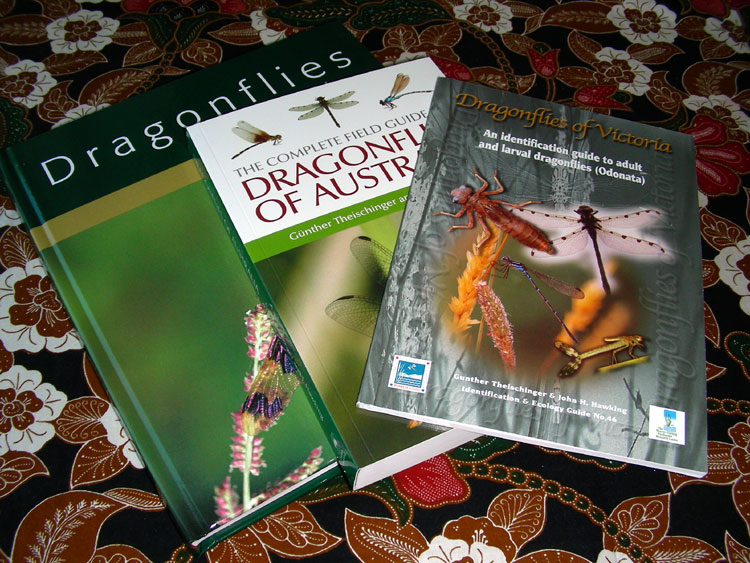 I'd forgotten I'd ordered these, so when I came home from the dentist's appointment to find the box on my doorstep, I was delighted.
 (Not with the Australia Post contractor who had left the box, mind you. I was furious about that. They might as well have nailed up a sign saying 'Not at home. Burgle at leisure.')
Cruel. But fair.
The Guardian's John Crace on Break no bones by Kathy Reichs.
He also took on the Booker Prize shortlist, so now you don't have to read any of them. Not even the winner.
The Inheritance of Loss by Kiran Desai:
A dead body turns up. Unexpectedly. Amid a slew. Of short sentences.
"Why does it always. Start like this?" Tempe Brennan said out loud, as she uncovered the rotting. Five-year-old corpse. With the strange mark on the C-6 vertebra.
"It ratchets up. The non-existent tension," drawled the sinister Southerner. From Charleston.
"Who are you?" snapped Tempe.
"The sinister property developer," sneered Dupree. "The one. You're meant to think. Is the baddie."
"I'm dying of cancer," sobbed Emma, the local pathologist.
"Well that kills two. Birds with one stone," Tempe shrugged. "Now I'll have to stay. In town to solve. The crime. And I'll have to hook up with my ex, Pete."
He also took on the Booker Prize shortlist, so now you don't have to read any of them. Not even the winner.
The Inheritance of Loss by Kiran Desai:
The description of the mist moving like a water creature across the great flanks of the Himalayas possessed of ocean shadows and depths told Sai that she had inadvertently found her way into a lyrical evocation of post- colonial multiculturalism. She picked up a copy of National Geographic. "That should add a nice post-modern ironic nod to globalisation," she reckoned.
Flash! Bang! Wallop! What a picture!
Or it would have been, if that nit in the front hadn't blinked.
Nic Svenson and Piers Barnes of CSIRO won this year's IgNobel prize in Mathematics for developing an equation to calculate how many group photographs you have to take before ending up with one that's blink-free.
The answer depends on the number of people, of course, but also on the light levels. (A camera shutter stays open for longer in low light, which increases the chance of it catching a blink.)
One person—piece of cake. Twelve people? Getting tricker, but if the light levels are good, four shots should do. Make it half a dozen if it's gloomy.
Get to thirty and you're going to have to take a shot per person. Fifty? Give it away. Someone's going to blink. Guaranteed. (And, anyway, a whey-faced IT wallah with a misplaced sense of whimsy will be making bunny ears behind the manager's head. Then it will all end in tears.)
CSIRO's Velocity has a summary of the findings.
Nic Svenson and Piers Barnes of CSIRO won this year's IgNobel prize in Mathematics for developing an equation to calculate how many group photographs you have to take before ending up with one that's blink-free.
The answer depends on the number of people, of course, but also on the light levels. (A camera shutter stays open for longer in low light, which increases the chance of it catching a blink.)
One person—piece of cake. Twelve people? Getting tricker, but if the light levels are good, four shots should do. Make it half a dozen if it's gloomy.
Get to thirty and you're going to have to take a shot per person. Fifty? Give it away. Someone's going to blink. Guaranteed. (And, anyway, a whey-faced IT wallah with a misplaced sense of whimsy will be making bunny ears behind the manager's head. Then it will all end in tears.)
CSIRO's Velocity has a summary of the findings.
Tuesday, 17 October 2006
Junior scientists
This is great. A CSIRO entomologist got together with a bunch of school students (7 –13 year olds) to describe a new species of gall-forming wasp. The children used a scanning electron microscope and digital imaging systems—and ended up naming the new species Tanaostigmodes shrek.
I'd like to read more scientific papers with an acknowledgment section like this:
Read more
Hardwick, S., Harper, M., Houghton, G., La Salle, A., La Salle. S, Mullaney, M. & La Salle, J. (2005). The description of a new species of gall-inducing wasp: a learning activity for primary school students. Australian Journal of Entomology 44: 409 –414.
I'd like to read more scientific papers with an acknowledgment section like this:
We would like to thank several people who helped us with this project. Everyone at CSIRO Entomology was very nice to us … Finally, our parents were all very supportive of this project, and drove us around so that we could do it.
Read more
Hardwick, S., Harper, M., Houghton, G., La Salle, A., La Salle. S, Mullaney, M. & La Salle, J. (2005). The description of a new species of gall-inducing wasp: a learning activity for primary school students. Australian Journal of Entomology 44: 409 –414.
Something to pond ... er ...
 The people in charge of campus call this an eyesore. Every now and then they empty it into the storm water system. (Is that legal?). Then they get a big bulldozer to scoop out all those nasty green reeds.
 When we argue with them that it's worth leaving, they scratch their scalps and say, 'Don't be stupid. How can it be? It's just a drain for the surrounding area.'
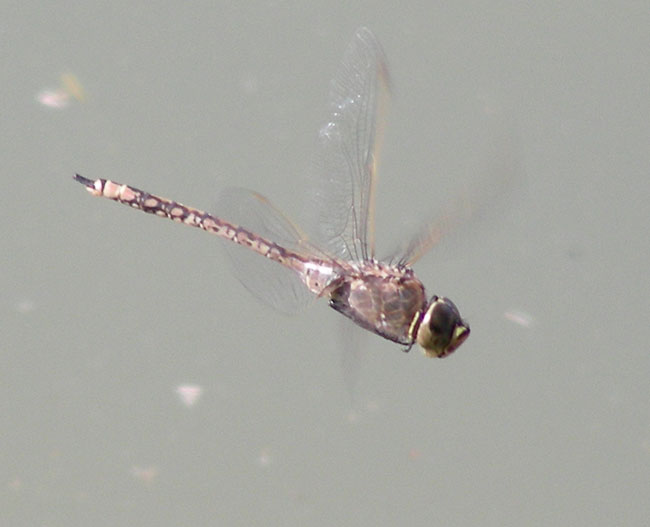 I strolled down there at lunchtime. It was too hot for much to be out and about, but I saw two species of dragonfly, a damselfly, an Australasian grebe and a water hen with chicks. At other times, I've seen Pacific black ducks, white-faced herons, moorhens and coots. Yes, what an eyesore ...
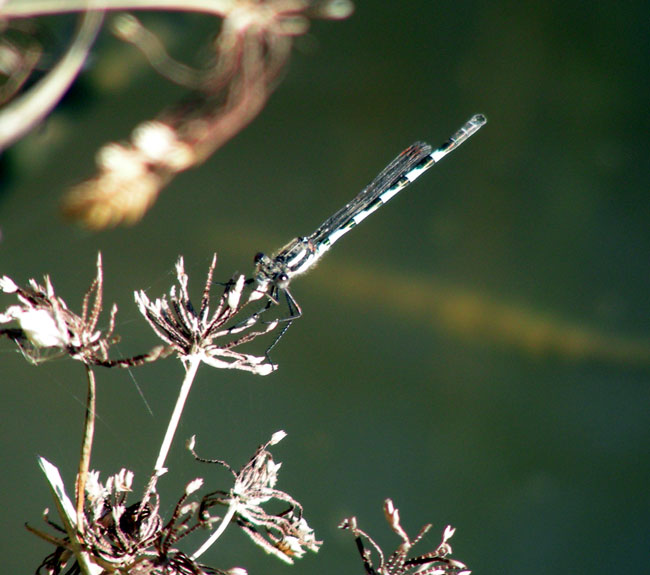 ... Quite unlike the weeds that they've planted in the garden beds. I'm pretty sure that half of them are banned from sale. And the other half ought to be.
The world's second worst birdwatcher
 Something moved in the grassland. A flash of white on the face. A flicking tail. Looked interesting.
 I didn't have binoculars, so I pointed the camera in the general direction. After all, I could crop and enlarge the picture later and see what exciting bird it was.
In my defence, I've got crap eyesight and it was a long way away.
But this is why I'm not leading bird watching tours.
Sounds of then
Amegilla, this one's for you. The rest of you might enjoy it too. GANGgajang's Sounds of Then from 1985.
Monday, 16 October 2006
White's worm wisdom
From Gilbert White's Natural History of Selbourne.
Lands that are subject to frequent inundations are always poor; and probably the reason may be because the worms are drowned. The most insignificant insects and reptiles are of much more consequence, and have much more influence on the economy of Nature, than the incurious are aware of; and are mighty in their effect, from their minuteness, which renders them less an object of attention; and from their numbers and fecundity ...
... A good monograph of worms would afford much entertainment and information at the same time, and would open a large and new field in natural history. Worms work most in the spring; but by no means lie torpid in the dead months; are out every mild night in the winter, as any person may be convinced that will take the pains to examine his grass-plots with a candle; are hermaphrodites, and much addicted to venery, and consequently very prolific.
Letter XXXV, May 20 1777
Lands that are subject to frequent inundations are always poor; and probably the reason may be because the worms are drowned. The most insignificant insects and reptiles are of much more consequence, and have much more influence on the economy of Nature, than the incurious are aware of; and are mighty in their effect, from their minuteness, which renders them less an object of attention; and from their numbers and fecundity ...
... A good monograph of worms would afford much entertainment and information at the same time, and would open a large and new field in natural history. Worms work most in the spring; but by no means lie torpid in the dead months; are out every mild night in the winter, as any person may be convinced that will take the pains to examine his grass-plots with a candle; are hermaphrodites, and much addicted to venery, and consequently very prolific.
On the book list ...
My reading list has settled down. I've just started Cormac McCarthy's No Country for Old Men, which should be subtitled No Book for the Faint-hearted. I'm pretty sure that nobody's going to be fashioning firearms from kitchen items in this one. And if they do, they'll get a face full of gunpowder and shards of casing. That's the sort of book it is.
I'm also dipping into a rather more genteel trio of anthologies—collections of the best writing from the Guardian's Country Diary and Birdwatch—as well as Gilbert White's Natural History of Selbourne. I'd like something of them to rub off on me. More than the ink, that is.
I'm also dipping into a rather more genteel trio of anthologies—collections of the best writing from the Guardian's Country Diary and Birdwatch—as well as Gilbert White's Natural History of Selbourne. I'd like something of them to rub off on me. More than the ink, that is.
A new blog on the block
Mixed Metamorphs is a brand new nature blog from the far SW of Western Australia. Now that's a part of the continent with a fabulous fauna and an even more sensational flora.
Welcome to the Blogosphere.
Welcome to the Blogosphere.
The venerable bees
Hoverflies aren't the only harbingers of spring. As the days grow longer, bees and wasps start buzzing around, visiting flowers and—in the case of many wasps—searching for insects to act as hosts for their eggs. (Nature isn't always pretty but it is consistently intriguing.)
Most bees and wasps are tiny, exquisite insects. They go about their business unnoticed. But a few are big, bright and bold enough to make a splash.
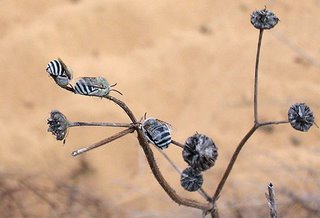 Blue-banded bees (Amegilla cingulata) are widespread across southern Australia. These males, photographed at Margaret River in WA, are snoozing on a thistle. Each has clamped his jaws onto a stem to hold himself in place. Although normally solitary, these fellows have gathered together over a pile of sand, where several females have dug burrows. They'll be the first on site when the females emerge in the morning.
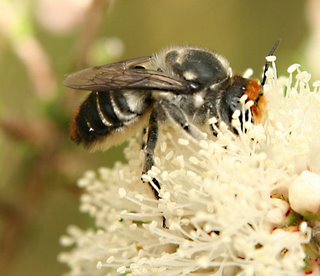 Beautiful as they are, blue-banded bees can cause problems by excavating burrows in mud bricks and mortar. Leafcutter bees (Megachile) aren't quite as destructive but will use holes and cracks in buildings to construct their small, leaf-lined nests.
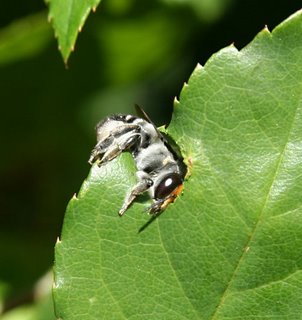 Females snip out pieces from leaves, which they then carry back to the home site and glue together. (The Airfix school of construction.) They prefer soft vegetation (they're not daft), so they tend to favour garden plants over more robust natives.
[Many thanks to MM for providing these stunning pictures of native bees.]
Most bees and wasps are tiny, exquisite insects. They go about their business unnoticed. But a few are big, bright and bold enough to make a splash.
 Blue-banded bees (Amegilla cingulata) are widespread across southern Australia. These males, photographed at Margaret River in WA, are snoozing on a thistle. Each has clamped his jaws onto a stem to hold himself in place. Although normally solitary, these fellows have gathered together over a pile of sand, where several females have dug burrows. They'll be the first on site when the females emerge in the morning.
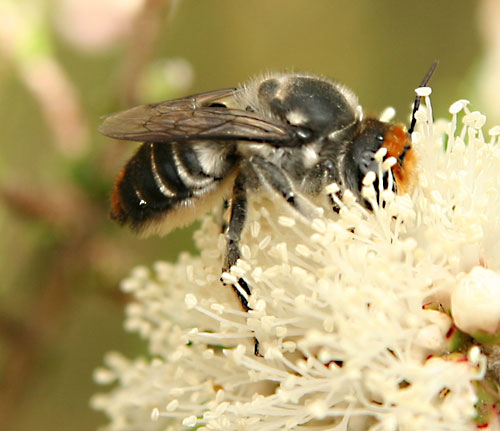 Beautiful as they are, blue-banded bees can cause problems by excavating burrows in mud bricks and mortar. Leafcutter bees (Megachile) aren't quite as destructive but will use holes and cracks in buildings to construct their small, leaf-lined nests.
 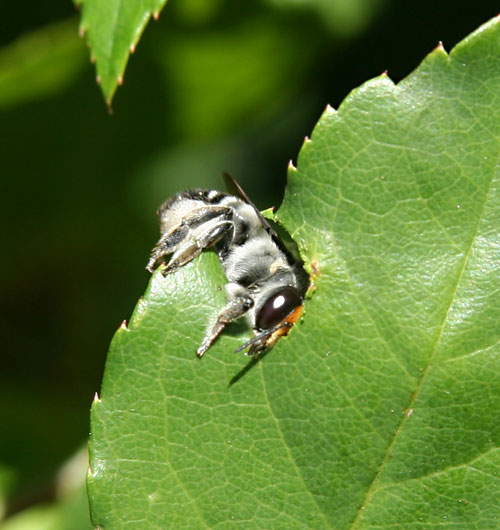 Females snip out pieces from leaves, which they then carry back to the home site and glue together. (The Airfix school of construction.) They prefer soft vegetation (they're not daft), so they tend to favour garden plants over more robust natives.
[Many thanks to MM for providing these stunning pictures of native bees.]
Tag team
Arriving here from I & the Bird? Puzzled by the lack of bird stories? Click on the label at the bottom of this post to rustle them up.
Shaking the tree
I used to enjoy this song—until Woman's Day appropriated it for ther advertising campaign. Here's the original sung by Peter Gabriel and Youssou N'dour. Try not to think about recipes and celebrity weddings when you listen to it.
Pharyngula has a clip of Peter Gabriel's In Your Eyes, which also features N'dour's extraordinary voice. Do yourself a favour.
__________________
The I-need-to-get-a-life moment for today. I wasn't paying attention when I wrote this post and claimed, for some entirely unfathomable reason, that the voice belonged to qawwali singer Nusrat Fateh Ali Khan. I was just dozing off, when the song played in my head, and I remembered it was N'dour. So I had to get out of bed, boot up the computer and correct the error.
For the record, Nusrat Fateh Ali Khan worked with Gabriel on the soundtrack of The Last Temptation of Christ. I haven't seen the film but I do have the soundtrack. It's fascinating, strange and beautiful.
Pharyngula has a clip of Peter Gabriel's In Your Eyes, which also features N'dour's extraordinary voice. Do yourself a favour.
__________________
The I-need-to-get-a-life moment for today. I wasn't paying attention when I wrote this post and claimed, for some entirely unfathomable reason, that the voice belonged to qawwali singer Nusrat Fateh Ali Khan. I was just dozing off, when the song played in my head, and I remembered it was N'dour. So I had to get out of bed, boot up the computer and correct the error.
For the record, Nusrat Fateh Ali Khan worked with Gabriel on the soundtrack of The Last Temptation of Christ. I haven't seen the film but I do have the soundtrack. It's fascinating, strange and beautiful.
Sunday, 15 October 2006
Wasp waste
I made two decisions this morning. Neither of them terribly significant.
The first is that I'm going to get the house to a stage where I'm not embarrassed to let people through the front door.
The second is that I'm going to learn more about Australian bees, wasps and ants (order Hymenoptera).
(I know. This is hardly Hold the front page! stuff. But I can't be on full throttle all the time.)
One of these is more difficult to achieve than the other. I'm not sure which. It's true there are about 15,000 described species of Hymenoptera in Australia, many of which can only be identified under a microscope by experts who have teased out their reproductive tracts. (That's the insects' reproductive tracts, not those of the experts.) And that could be considered a bit tricky, taking years to amass the relevant scientific literature and hone the necessary skills. But ... well ... you haven't seen my house.
 So here is the first step in my new-found interest in native bees, wasps, ants and sawflies. (Second step, if you count this fuzzy bee photo.) It's a wasp. Or a bee. No, it's probably a wasp. (No, not the bug in the middle. The thing up in the top left corner.) It was on my weeds. Now, if I had all the relevant scientific literature, the necessary skills, a microscope and an expert with teased out reproductive tract, I could tell you what it was.
But I haven't. So I might just clean up the bathroom instead.
The first is that I'm going to get the house to a stage where I'm not embarrassed to let people through the front door.
The second is that I'm going to learn more about Australian bees, wasps and ants (order Hymenoptera).
(I know. This is hardly Hold the front page! stuff. But I can't be on full throttle all the time.)
One of these is more difficult to achieve than the other. I'm not sure which. It's true there are about 15,000 described species of Hymenoptera in Australia, many of which can only be identified under a microscope by experts who have teased out their reproductive tracts. (That's the insects' reproductive tracts, not those of the experts.) And that could be considered a bit tricky, taking years to amass the relevant scientific literature and hone the necessary skills. But ... well ... you haven't seen my house.
 So here is the first step in my new-found interest in native bees, wasps, ants and sawflies. (Second step, if you count this fuzzy bee photo.) It's a wasp. Or a bee. No, it's probably a wasp. (No, not the bug in the middle. The thing up in the top left corner.) It was on my weeds. Now, if I had all the relevant scientific literature, the necessary skills, a microscope and an expert with teased out reproductive tract, I could tell you what it was.
 But I haven't. So I might just clean up the bathroom instead.
Saturday, 14 October 2006
A bunch of biodiversity
It's been a bumper month so far for uncovering new species of megafauna, charismatic (furred or feathered) or otherwise (scaly or smooth).
A big-headed mouse from Cyprus (Mus cypriacus).
A new subspecies of brush-finch in the Colombian rainforests. Not quite the new species announced on the news services but the tenth subspecies of Atlapetes latinuchus. Science Daily has a story about it or you can read the original description.
A couple of amphibians from the tropics. An Ansonia toad from Malaysia and a tree frog Dendropsophus juliani from Bolivia.
And plenty of fish. Nandus prolixus from the Sepilok River in Sabah on the island of Borneo, two species of Trimma gobies from the Western Pacific and a chimaera, Hydrolagus mccoskeri, from the Galapagos Islands.
A big-headed mouse from Cyprus (Mus cypriacus).
A new subspecies of brush-finch in the Colombian rainforests. Not quite the new species announced on the news services but the tenth subspecies of Atlapetes latinuchus. Science Daily has a story about it or you can read the original description.
A couple of amphibians from the tropics. An Ansonia toad from Malaysia and a tree frog Dendropsophus juliani from Bolivia.
And plenty of fish. Nandus prolixus from the Sepilok River in Sabah on the island of Borneo, two species of Trimma gobies from the Western Pacific and a chimaera, Hydrolagus mccoskeri, from the Galapagos Islands.
The secret life of weeds
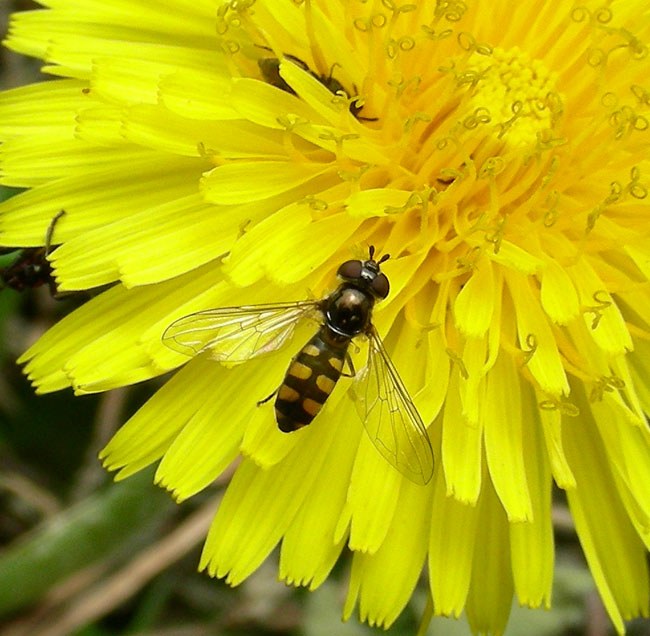 I am weeding my garden. It's a slow and tedious process. It's not helped by the insect activity around the flowers. How can I haul them out of the ground when they're covered in feeding insects?
You know that spring is here when the hoverflies are out and about. Adults dart from flower to flower, feeding on nectar and pollen. Their larvae dine on fungi and aphids. (Some species have aquatic larvae known—accurately if not flatteringly—as rat-tailed maggots.)
Hoverflies are harmless*. They don't bite or sting. But the black-and-yellow banding and the wing-buzzing (in some larger species) might mislead predators into thinking that they're looking at bees or wasps. Afraid of being stung, they leave hoverflies alone to get on with the business of zipping around flowers and ushering in spring.
_________
* If you're not a fungus or an aphid
Why cat runs are a good idea
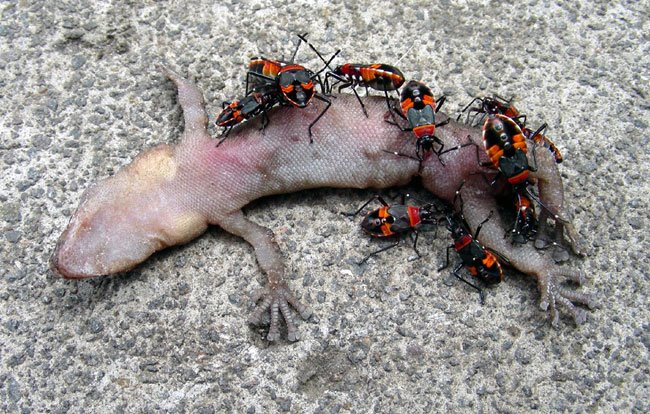 Not to mention the dreadful sight of someone's companion animal lying dead on road after being hit by a vehicle.
From my garden. I will be having a word with the neighbours.
Friday, 13 October 2006
The real McCoy
 Museum Victoria has a delightful on-line exhibition, Caught and Coloured, about Frederick McCoy's Prodromus of the Zoology of Victoria.
 McCoy established the natural history collection that became the National Museum of Victoria. In 1858, he began his Zoology of Victoria project. Over the next 40 years, artists produced more than a thousand plates covering a range of native fauna. Museum Victoria has reproduced a number of the plates on their site, accompanied by extensive information on the history of the project and the techniques used.
[I'm not sure why their plate of leeches is titled 'slug'. Perhaps they should have checked that one out beforehand. I might send them an e-mail ...]
Subscribe to:
Posts (Atom)