Thursday, 31 August 2006

I went out to document more of the exciting wildlife in my back yard. I saw a beautiful, fat, slater-eating spider (Dysdera crocata) but couldn't get a good photo. I did find a couple of false wireworms (Gonocephalum), which are sitting in a Petri dish, waiting for their moment under the lens. I will go out looking for more exciting subjects on the weekend.

In the meantime, here's another pair of pyrrhocorid harlequin bugs, Dindymus versicolor, at it like knives in the kangaroo apple. This shot shows the stunning green and yellow traffic-light bellies. Only a very brave or very naïve predator would risk a meal of this species.

I mentioned yesterday that I'd seen them feeding on all sorts of unsavoury items. They've also been recorded scavenging on dead caterpillars. (Specifically, Teia anartoides, the painted apple moth.)

Although many of the most prolific garden pests are introduced, Dindymus versicolor is all ours. It occurs throughout south-eastern Australia, including Tasmania. It's also found in New Zealand.
Mark Watson, hilarious fake-Welsh-accented over-achiever, is writing a novel with help from his audience. His plan was to complete a chapter a day. Speed, I suspect, is more important than quality in this exercise. You can read the results on his blog.

The black-and-white flower show

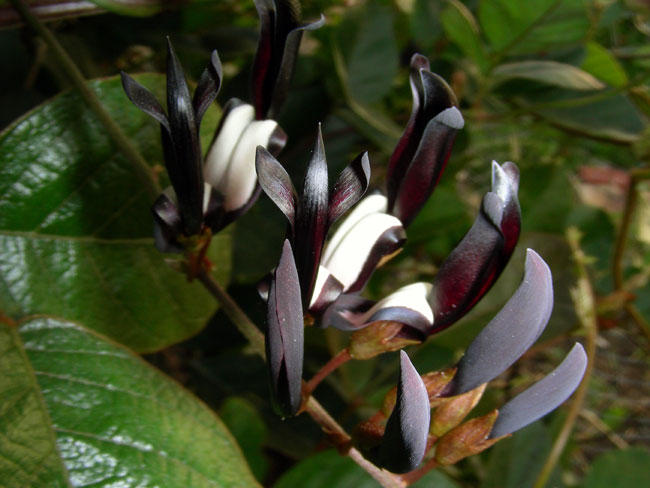
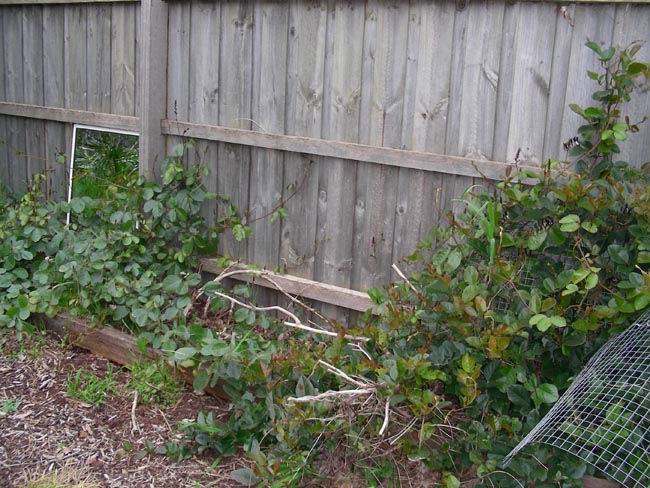
Planting black coral vine (Kennedia nigricans, Fabaceae) in my tiny garden was a big mistake. To call it vigorous is an understatement. It is vigorous in the way that Caligula was high-spirited.

Kennedia nigricans occurs naturally along the southern coast of Western Australia, from Albany to Esperance. It does well in cultivation to the point of being a weed in the Adelaide Hills. It's not quite a weed in my garden but I've noticed tendrils insinuating their way through the fence and sneaking across the lane.

When British botanist John Lindley described this species from plants raised in cultivation, he wrote that it was "a fine addition to the species of green-house twiners". I'm sure that Lindley wouldn't have been quite so enthusiastic if his greenhouse had disappeared under a glossy green that seems to double in size every day.

Still, it's worth the effort for the stunning black flowers. This is the cultivar 'Minstrel'. In wild-type plants, the patch on the standard is a stunning lemon yellow.

Congratulations ...

... to Peter Temple for winning the Ned Kelly award for best novel with The Broken Shore.

Four NK awards, eight novels. That’s a hell of a strike rate. The pool room must be getting full by now.

Wednesday, 30 August 2006

Burgess birthday

According to that mine (and sometimes minefield) of information, Wikipedia, today is the 97th anniversary of Charles Walcott's discovery of the Burgess Shale fossils in British Columbia, Canada.

Although not considered of great significance at the time, when the animals of these mid-Cambrian rocks were re-examined in the 1980s their prehistoric weirdness became a popular topic of discussion.

Remarkable preservation in shale allowed palaeontologists to learn much about their form and function. And what a weird bunch they were (the fauna, not the palaeontologists.) Five-eyed Opabinia. Multi-spined Hallucigenia (reconstructed upside-down and turned into a stilt-walker the first time around). Rapacious predator Anomalocaris. A rich and wonderful menagerie.

Back in black

I confess that I once bought a Studmuffins of Science calendar from the Annals of Improbable Research. (They don't seem to produce them anymore. I can't imagine why.)

Here's a calendar that I never thought they'd make. But now they have made it, how could I resist? It'll be up on my office wall next January.

[Thanks to Menno for bringing it to my attention.]

A bug's life

What I know about bugs could be carved into the tip of an antenna with room left over for a horde of foxtrotting angels. But I wanted to try out the macro on my new digital compact camera and this is the result. Not bad, eh?

These bugs infest my garden. They congregate into scarlet and black swarms—adults and nymphs of all stages. I haven't noticed them doing a great deal of damage to my plants but that might well change when I start uprooting the weeds.

I'm not sure of the species. I think it's Dindymus versicolor, one of the multitude of brightly-coloured insects given the common name 'harlequin bug'. Five species of Dindymus occur in eastern Australia, all of which are plant predators. But Dindymus versicolor doesn't appear to be too fussy about its diet. I've seen them gorging on squashed slugs, bird poo and—I wish I hadn't observed this—cat shit. Some SE Asian species are snail-killers. The fiends!

My garden is packed with these bugs. They're certainly prolific breeders. Adults are rarely found on their own. They're usually in mating pairs, as is this case with these ones on the kangaroo apple (Solanum lacinatum).

Even in high densities, they don't seem to be doing much damage to my plants but that might change when I start pulling out the weeds, leaving them alone with my lovely natives. These bugs are on notice.

Tuesday, 29 August 2006

They call them the wanderers

Millions of monarch butterflies (Danaus plexippus) are about to begin their mass migration from southern Canada and the northern United States to their wintering grounds in California and Mexico.

Although native to continental America, monarchs have spread far from home. They are widely distributed in Hawaii (where a black and white form occurs on the Big Island) and Guam. Stragglers were apparently reported from eastern Australia as early as 1856. They were well established by 1878, when this drawing was made of a caterpillar in Tasmania.

The caterpillars feed on poisonous milkweed (Asclepias), cotton-bush and swan plant (Gomphocarpus), all of which have been introduced to Australia. They are undeterred by the plants' toxins. So undeterred that they store them to use for their own defence. To warn potential predators of the danger, the caterpillars sport vivid aposematic coloration.

Making a meal of poisonous weeds stands them in good stead. They keep the toxins through metamorphosis into the adult stage.

With their prodigious powers of flight, wanderers have dispersed across Australia. Their dependence on introduced plants has restricted their establishment in many areas but as the weeds spread, so do they. Although spectacular, the butterflies are signalling the decline in our natural environment.

Zion

Utah is a strange place. Nothing makes you more desperate for a drink than travelling through towns where alcohol is in limited supply.

I arrived in Cedar City during the Shakespearean Festival. I didn't know that it was on, so you can imagine my confusion when I drove down a main street where everyone was dressed in doublet and hose or long dresses and tall pointy hats with veils. As far as I knew, this was how the good folks of Cedar City always spent their weekends. I didn't say anything about it. And no one mentioned it to me.

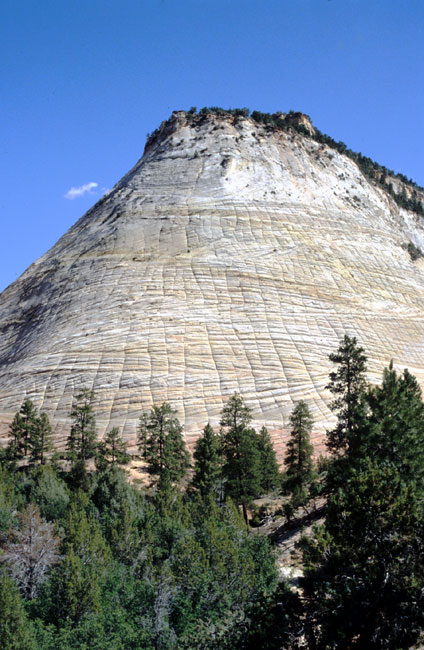
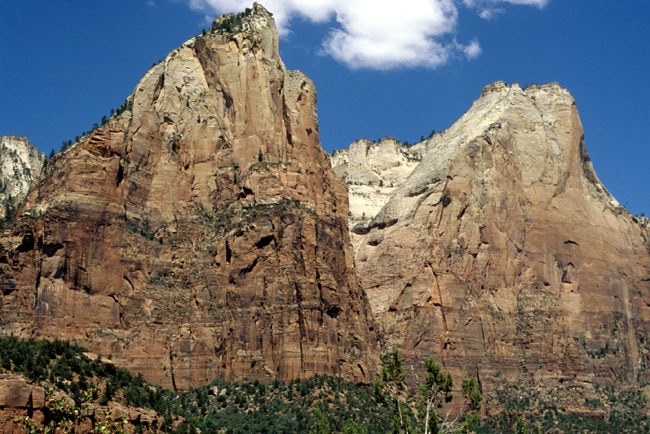
Why was I in Cedar City? I was heading north from the fabulous sedimentary geology of Arizona on my way to the wild volcanic geology of Idaho. Zion Canyon was on the way.

I love geology. I don't know much about it. As with Uluru, I'll let the pictures of Zion National Park do the talking.


Lights, camera, inaction

I took the new digital camera into work but didn't get a chance to stroll around campus pointing it at things of interest. Not such a big loss, as the 'partly cloudy day' forecast by the Met Bureau was a completely cloudy day. There's always tomorrow. After the three-hour instruction session on how to fill in the staff development planning form online. Three hours! And the bloody form isn't active anyway. Give me strength!

Oh, and a lecture too. I forgot about that.

Monday, 28 August 2006

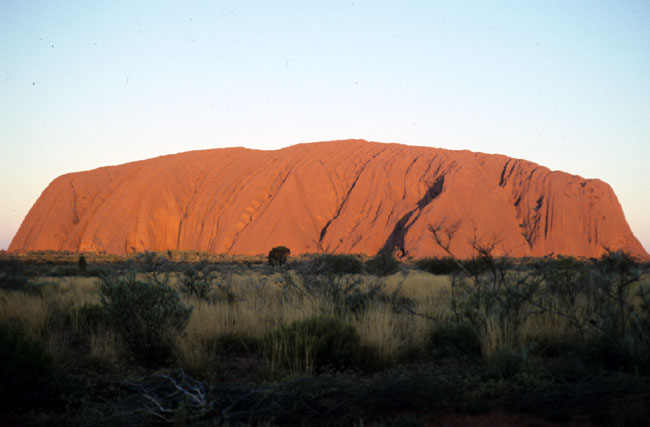
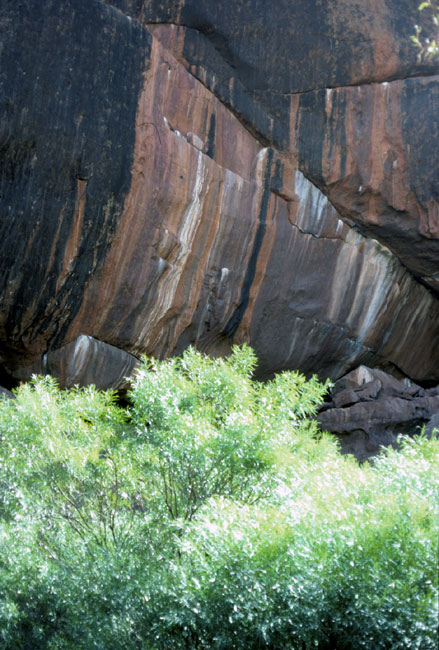
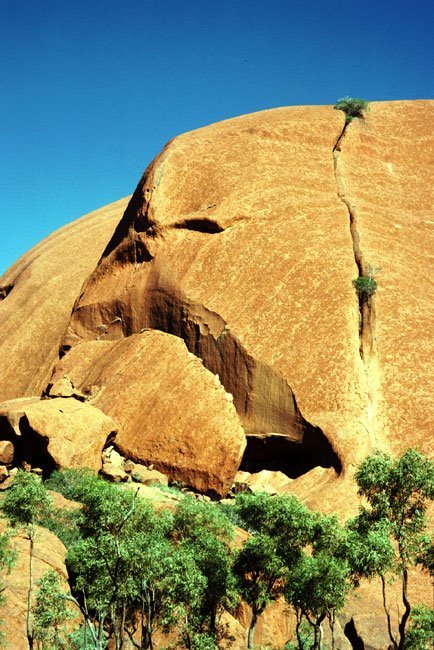
I'm going to let these photos of Uluru (Ayers Rock) speak for themselves.


My disgraceful garden!

It hasn't always been an embarrassment. Before the builders came, my garden wasn't exactly a showpiece but it was tidy, colourful and weed-free. Now, it's just a mass of weeds and mud. One day it will be a joy to behold etc but, right now, it is as work in (slow) progress.

First problem is the side path. This is the only way in and out of the back garden, other than through the house. That gate is rotten and held in place by the bolt. I haven't got round to getting a new one yet. More accurately, the person who was supposed to be making it for me has disappeared off the face of the earth.

You can see that the path is concrete. The plumbers dug that up to re-do the drainage. (Must have been a real pain, because this area is pure clay.) Unfortunately, they didn't pack the clay down again. And neither have I. So the path changes from concrete to clay (isn't that a song?), which is impassable in the wet weather and undiggable in the dry. This doesn't bother the weeds as you can see. For those interested, the plants are (from front to back):
  • Swamp lily (Crinum pedunculatum)
  • Firewheel tree (Stenocarpus sinuatus)
  • Cunjevoi (Alocasia brisbanensis)
  • Tree ferns (I can never remember whether they're Dicksonia or Cyathea. I've got a complete mental block.)
  • Fan flower (Scaevola aemula)
  • Snowy mint bush (Prostanthera nivea)
There's a bunch of other stuff you can't see but I'll take more photos on a sunnier day.

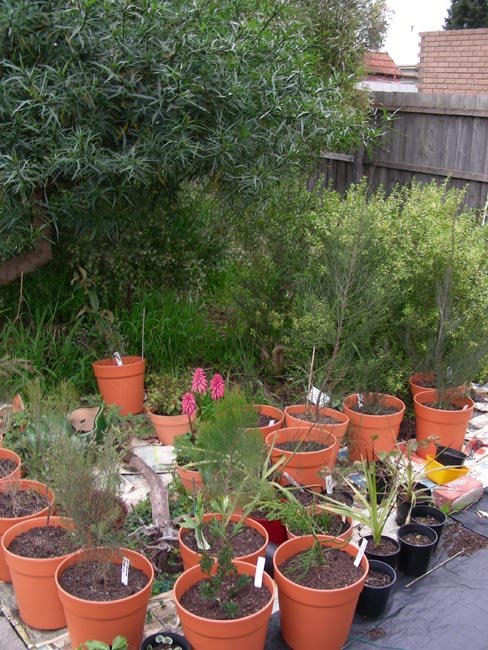
This is the view from the back door. The silvereye-attracting kangaroo apple (Solanum lacinatum) is on the left. In front is part of the Casuarinaceae collection, plus a few other bits and pieces, including the stunning pink flowers of the South African Veltheimia and a couple of native conifers. The shrub with new growth is an emu bush (Eremophila maculata). The insects love it when it flowers.

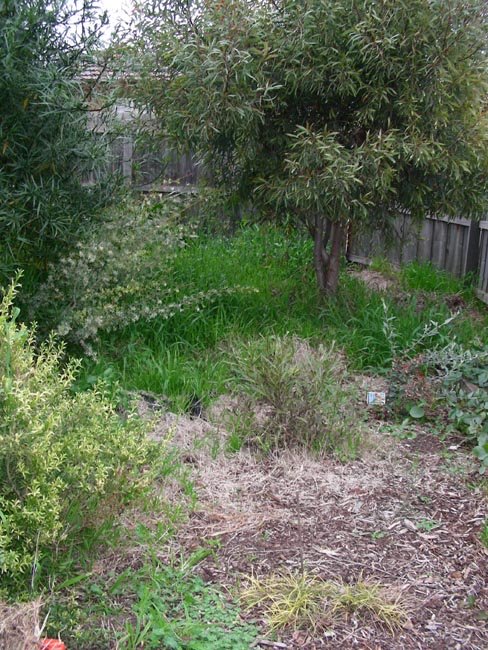
Two or three paces along the weed mat and this is the view ... I've killed the couch but haven't quite got round to ripping it up. The neighbour's four cats love the mulch. They think it's a great place to shit. Rampant weeds and dead couch are the only things corralling their toilet activities at the moment. I have to be very careful where I step. The apparently moribund plant in the foreground is Grevillea nudiflora. New growth is a bilious yellow-green. That tree is a pincushion hakea (Hakea laurina).

This final shot is part of the Kennedia collection. Kennedia is a small genus of climbing or scrambling plants endemic to southern Australia. These really are worth some close ups. If the sun's out tomorrow and I get good photos, I'll do a Kennedia blog. In the meantime, we'll have to make do with a distant shot. The plant on the right is black coral vine (Kennedia nigricans). The wild form has black and yellow flowers. This one is cultivar 'Minstrel'. As you've probably worked out, the flowers are black and white. Very handsome they are too.

On the right is Kennedia retrorsa, which is a short-range endemic from New South Wales. It's covered in buds but isn't quite ready to bloom. The flowers are a startling cerise. I'm looking forward to this one bursting forth.

(Okay. I'll come clean. This is about me learning to use my digital camera. I bought it, took it home and spent too long reading the instruction manual. So by the time I felt confident enough to point and click, it was late afternoon and starting to get dark. Bear with me!)

Sunday, 27 August 2006

The shortest syndication in the history of the universe. (Be aware that I don't want to tumble in hyperbole here.) I upgraded to Blogger Beta. I fiddled around with feeds. I changed to a new template that already had the feed code in it. And then I was warned that my e-mail address was popping up with every post syndicated.

So I've taken both my e-mail address and the Atom feed out. That should solve the problem.

I hope.

Housekeeping

I reduced the number page size from a week's worth to the last five posts. I wanted to make sure that loading wasn't going to be a problem for dial up. So don't think I've been slack when you see a short page. Check out the archives!

Join the FNQ!

Have booked my accommodation in Far North Queensland for a short break in September. It's actually a field trip but the university red tape* is now so ridiculous that I gave up on that and took annual leave instead. At least now I can stay where I want, change my plans at the last minute and have a look at potential study sites without having to justify every movement.

I'll be staying at Chambers Rainforest Lodges at Lake Eacham. It's a top spot for anyone interested in natural history. Last time, I didn't even have to leave my verandah to see a huge range of birds, including orange-footed scrubfowl, Victoria's riflebirds and spotted catbirds. (I think I only added another two to the list after lengthy strolls around the lake—tooth-billed bowerbird and great crested grebe.)

I'm going to have to buy a digital compact camera too. I can't face lugging the (film) SLR and lenses and the binoculars around. I must be getting old.


*Don't get me wrong. I don't have a problem with the forms. They're fine. It's the nitwittery associated with processing them that shits me. Don't get me started.

And it's got much worse ...

Australian fantasy writer, Sara Douglass, used to lecture at LaTrobe University's Bendigo campus. She got out of the Academy as soon as practicable. Her reason for quitting?

This job was the most stressful I have ever held. The interdepartmental politics, the teaching, the emphasis on research even though you never had enough time or the facilities to do it
.

And that was in a discipline that didn't have field work or experiments. What hope for the scientists?
Looks like I won't be able to get to the Melbourne Writers' Festival this year, which is a shame. Instead, I'll have to get the professionals to take notes for me. Such a pain because I really enjoy listening to authors talk about their work. Less fascinating when someone in the audience (often another writer) hijacks the Q&A session. The Chaser produced a great guide on how to ruin festivals for everyone else.

[DISCLAIMER: Occasionally The Chaser slips into bad taste. This is, fortunately, a very rare event.]
Well, I'm delighted. I wandered into what passes for a back yard this afternoon and found the kangaroo apple (Solanum lacinatum) host to a flock of silvereyes (Zosterops lateralis). As the kangaroo apple is only two metres from my back door, I caused a stir among the birds. I didn't try to take a photograph. I'd rather have the silvereyes flitting about in the garden than only a photo of them to post on the web.

Silvereyes are no great deal for most people. They're common in gardens, parks and woodlands. But my house is in an urban area with no large gardens, few parks and you can just forget about the woodlands. I don't know how far the birds roam. Are they nomadic? Perhaps the flock came in from the Maribyrnong River, where there are large gums.

As my garden is only about 100m2 (with a shed and a Hill's hoist in it), the birds were packed together like chooks on a battery farm. Makes bird watching easy, though. And to think I was going to get rid of the kangaroo apple ... Its continued existence is assured.

(For more on kangaroo apples, see this earlier post on A Snail's Eye View)

Saturday, 26 August 2006

Babysitter snails

While skimming the newfangled electronic intaweb for information about deep sea organisms, I found this little wonder: a species of Neptunea (family Buccindae) that looks after its eggs.

Usually, snails are not good parents. Once they lay their eggs, that's yer lot. (No wonder snails do so much damage in the garden. Put it down to deprived childhoods.) This species lays its eggs in a column, adding them in a spiral until its exhausted the reserve. Then, instead of a slow-motion skedaddle, mum stays at the top. She tends the eggs until they hatch and then she dies. Such is life.

Researchers on the submersible Alvin photographed these snails around methane seeps more than half a kilometre down off the western coast of the United States. It's a whole different world down there.

Melbourne mangrove mud-ness

(I know that title doesn't make much sense.)

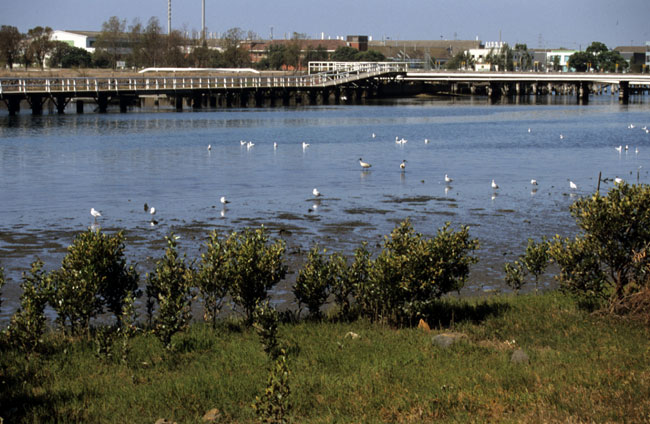
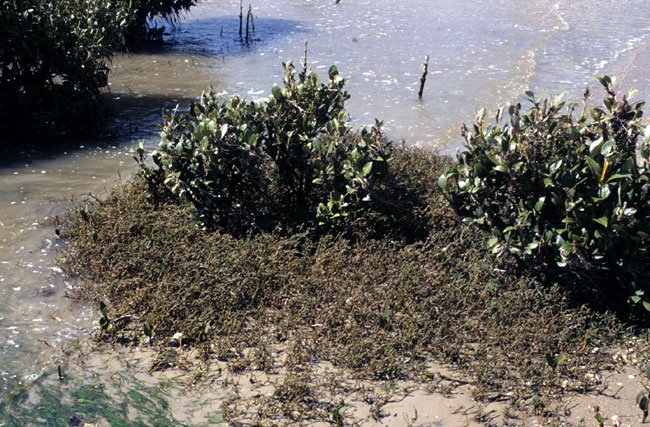
Melbourne has mangroves. They're not very big. In fact, they're pretty bloody small. But we have them and they're accessible at a spot close to the city.

Stony Creek Backwash is at the base of the Westgate Bridge in Yarraville. It's administered by Parks Victoria and cared for by the Friends of Stony Creek.

Back to those mangroves. They're Avicennia marina, the white mangrove, a tough bugger that manages to survive close to industrial areas. An oil spill in the 1980s destroyed the original population. These have been replanted from seedlings collected on the Barwon River.

Despite the small size of both the park and the mangroves, the backwash attracts a variety of wading birds including royal spoonbills and egrets. Silver gulls and white ibis are ubiquitous.

I haven't had a close look at what's living in the mud. I should nip down there one day when the tide's low and have a paddle around. I may get arrested for behaving suspiciously at the base of a large and important bridge but I'm prepared to risk it for science.

(For people who don't know Melbourne, that bridge in the first picture is not the Westgate. We're not quite that backward down under. The Westgate is the big-arse bridge you can see in the first link.)
(I've noticed other people doing this ...) What I'm listening to right now: Icehouse by Flowers. (Who subsequently became Icehouse but never had a song called Flowers. Go figure.)

There was a fire at work on Friday evening. Luckily. That meant that we sad souls who were still in our offices at 5.45 pm were forced to leave the building. We loitered around the main entrance, blocking access for two fire engines and an LPG response van, for about fifteen minutes in the hope that we'd be able to return to finish off the day's work. Then it dawned on us—we could go home.

So we did.

It was a bit annoying, though because the newly-formed Solemya group (aka Desperate and Date Shell-ed) (yes, we're working on that slogan) was on a roll. It'll take days to work up our enthusiasm to that level again. (Not that it'll do us any good. It's pure research so not worth a fig.)

Friday, 25 August 2006

I'll be back tomorrow with some livelier stuff. Trust me.

R Q Effed

The morning started with promise, lunch was good (we walked over to the kebab house and stuffed our faces on meat and dips) but much of the afternoon was wasted on discussing the Government's Research Quality Framework.

For those of you who are not familiar with this ... thing ... it began with Brendan Nelson trying to constrain academic research to those areas that would produce immediate benefits to 'end-users' (a euphemism for industry). He established the Expert Advisory Group, which produced a model for assessing quality and impact. Then Nelson went to the Armed Forces ('I see no ships'). His successor, Julie Bishop, has now peed all over the RQF tree. So far, she has established a new group to 'take forward the next phase'. This is the Development Advisory Group (that's right, the acronym is DAG).

(In her favour, at least Bishop doesn't believe that Intelligent Design has a place in science classes. Nelson did. No doubt he still does. I couldn't imagine he said that simply to get in the Fundies' good books.)

The RQF measures quality and impact of research. Impact is an interesting concept. Having agreed that pure and applied research are equally valid (Section 2.2. of the Final Advice), the EAG then set up a model that complete ignores it. That's right. If you do pure research (or if your research isn't turned into something 'useful' within six years) you're up shit creek.

Furthermore, each research group is expected to produce a report (of no more than ten pages) explaining how the past six years' research has benefited the end-user community. Then the group has to supply the names and contact details of those beneficiaries so they can be called on as referees.

No, I'm not making that last bit up.

Here's the break down.

A+ Research has produced transformational benefits on a large scale, resulting in sustained social, economic, environmental and/or cultural outcomes.

A Research has produced benefits resulting in significant improvements in a defined social, economic, environmental and/or cultural context

B Research has generated new policies, products, processes or paradigms, resulting in demonstrated uptake by the relevant end-user community

C Identifiable beneficial engagement with end-users recognising the importance of the research for a defined social, economic, environmental and/or cultural issue.

D Research has a negligible social, economic, environmental and/or cultural benefit for the end-user community and/or end-users have not engaged with the research within a reasonable timeframe.

Not assessed Research is too early to have made an impact or, due to its intrinsic nature, is not expected to result in straightforward end-user benefits.

I'll have to finish this before I have my break down.

Thursday, 24 August 2006

Ancient Arizona

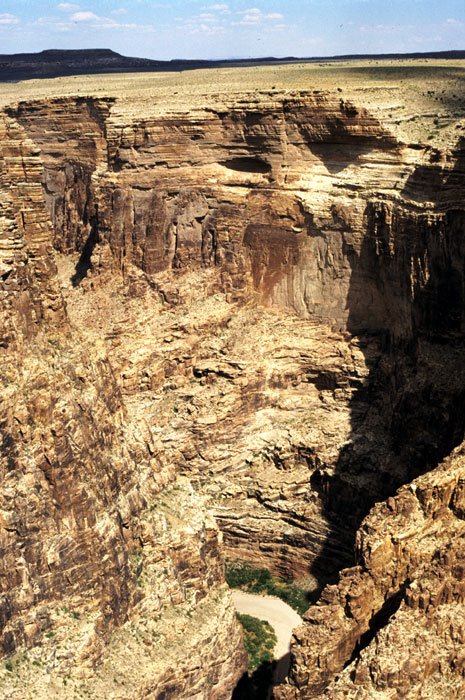
I don't know enough about Arizona to tell you much about these pictures. All I can say is that the South West does brilliant geology. The first two photos are from Little Colorado Canyon. (Yes, it's an unusual use of the term 'little'. But remember that there's a slightly larger canyon not far away from this spot.) The third photo is of a silicified tree trunk in the Petrified Forest National Monument.


Mites are all right

On my list of things I must do when I get spare time* is the entry 'look at Riccardoella'.

Riccardoella is a genus of mites that lives in the lungs of slugs and snails, where they slurp up mucus and nibble on skin. There's an extraordinarily good picture of these critters on the Canon digital photographers' forum. (Thanks to Dark Orange for the link.)

As far as we know, the mites only occur on introduced slugs and snails in Australia. They don't seem to have made the jump to our local animals. Furthermore, there are two species—R. limacum, which lives on snails and R. oudemansi, which is only found on slugs. Why is there a difference? After all, slugs are simply snails without shells. What's keeping the mite species apart? Is it something to do with the mucus or the behaviour? Maybe there's really only one species that's variable in form? Or could there be a flock of very similar species that live on one or a few types of snail and/or slug?

And is it time for my medication?


*I may have plenty of breathing space to do all this when I'm sacked for insubordination.

Australian International University: more better education®

These people know how the Academy works.


The mission statement
To educationalise our globally significant clientele for maximum ROI with a view to a spectacular IPO.

The staffing policy:
At Australian International University we have no staff. We are a revolutionary, management only university. By cutting out staff members completely, we have reduced our costs to a market-leading level, enabling us to provide our clients with world-class price point options.

All lecturers and tutors at Australian International University are SSP’s. SSP stands for “Subcontracted Service Provider.” The utilisation of SSP teachers keeps costs as low as possible for us. We can then pass on these cost savings to you, our valued clients.


Here at AIU we are also very proud of the fact that our management staff have absolutely no academic experience. Our management team have all been recruited because they come from management, marketing and entrepreneurial backgrounds. We guarantee that none of them are tainted by any experience of pedagogy. George Bernard Shaw once wrote, “Those who can, do. Those who can't, teach,” or words to that effect. Except for our SSP’s, all management staff at AIU are able to “do.”


It's too accurate to be funny.

Wednesday, 23 August 2006

At last, ABC's The Glass House has caught up with this news, which A Snail's Eye View commented on ages ago. What took them so long?
I haven't quite gone yet. I was going to sneak a look at an interesting paper I found in one of the journals today. It was all about the size of deep sea animals: why those organisms that are small in shallow waters tend to be bigger at the bottom of the ocean and vice versa. Of course, I've left it at work. Instead, I've brought home the notes from this morning's lecture on community ecology. What a winner.

I've also been scouring the research literature for studies on blogs. Yes, there's a body of literature on this topic. Surprisingly, much of the stuff I've found is neither incomprehensible nor pompous. Some of it is a bit nerdy. Most of it is self-conscious. But it's remarkably readable. More of that when I get the chance to synthesise it.

In the meantime, with first year essays and their idiosyncratic punctuation looming like a dust storm on the horizon, here's something from Terry Pratchett's Going Postal.

A. PARKER & SON'S
GREENGROCER'S
HIGH CLAS'S FRUIT AND VEGETABLE'S

Tuesday, 22 August 2006

Diet of worms

In one of yesterday's posts I mentioned that Angiostronyglus cantonensis, the rat lungworm, was found in Australia and that infections occur in humans from time to time. (I didn't say it in those words exactly but that was the gist.)

I'm a fan of parasites. They're marvellous animals, much maligned by us. If I had to make a list of my favourites, the flukes would be at the top and the nematodes down towards the bottom. But they'd definitely be on the list. Even if their life cycles are a touch on the dull side, comparatively speaking.

Angiostrongylus is a nematode. Adult worms live in the pulmonary arteries of rats. Their larvae migrate through the lungs and are swallowed. They pass out in poo, which is grazed on by snails and slugs—and crustaceans, if it drops into water. The juvenile worms develop in this intermediate host but do not reach adulthood until they're in the definitive (final stage) host, usually a rat.

Once in the rat, they burrow through the gut wall and worm their way through tissues until they arrive at the spinal cord. From there, they wriggle along to the brain. On reaching the brain, they hang around for a while, living it up among the grey matter. Then they mosey on down to the arteries of the lung. And the cycle begins again.

Although they infect humans, the worms are not well adapted to life in us. They often don’t get very far and are cleaned up by the immune system before they can do much damage. Even if ensconced in the brain, infection frequently passes unnoticed. Eventually, the worms die. End of story.

In other cases, the worms cause eosinophilic meningitis. A very small proportion of those infections may be fatal.

Although the parasite is widely distributed in South East Asia and the Pacific Islands, it has also been spread to other parts of the world. In Australia, human infections have been reported from Queensland and New South Wales.

A range of snail species harbour the larval stage, including the giant African snail (Achatina) and many slugs. In a 2001 case in Sydney, a young man ended up in hospital after eating a couple of slugs for a dare. It took five weeks before the nematodes got the better of him. But when they did, he was in trouble.

Eating intermediate hosts is a great way to get a case of Angiostrongylus. That was the method of infection in the Beijing case. And it doesn't have to be snails or slugs. Raw prawns are just as good.

And the moral of this tale? If you’re going to eat a slug for a dare, cook the bloody thing first.

DISCLAIMER: I am neither a medical practitioner nor a particularly good cook.

Monday, 21 August 2006

With wormiest dishes ...

Reported in the China Daily, where you can read the whole gruesome story. (And before you're enjoying too much schadenfreude, you should know that it could easily happen here.)


EATING SNAILS LEADS TO MENINGITIS IN BEIJING

At least 50 people have been diagnosed as suffering from a parasite-caused meningitis after eating raw or half-raw snails at Beijing restaurants.

It is the first time the so-called Guangzhou Angiostrongylus meningitis has been found in Beijing, according to the Beijing Municipal Health Bureau's website.

It has warned people not to eat raw seafood, which may carry parasites that threaten health.

The first case, involving a 34-year-old man, was found by the Beijing Friendship Hospital in June.

The patient suffered from unbearable headaches and nausea after eating a dish called cold snail meat in the Shuguo Yanyi Restaurant.

The snail meat was from Amazonian snails Fushouluo in Chinese a popular dish in Sichuan-style restaurants in Beijing

Doctors took samples from the restaurant and found the parasite in two of the snails.
Just realised that even though I've used the personal pronoun a lot, I haven't actually said much about what I've been doing recently.

That rave about Solemya was prompted by Friday afternoon's water cooler conversation at work. Well, it wasn't really around the water cooler. It was in my office. What started as a slightly flippant comment about collaborative research grew like a hairball when the three of us (a microbiologist, an evolutionary geneticist and a zoologist*) began to throw ideas around. It turned silly when we realised that Solemya are also known as date shells but we got over it.

Those animal–bacterium or animal–protist mutualisms are really fascinating. One of the shallow-water American species, Solemya velum, has been studied extensively as a surrogate for deep sea bivalves. We're thinking of taking a look at the local species and its symbiotic bacteria in detail once the semester settles down. I'll have to apply for collection permits because we'll be working within Port Phillip Bay (I know the best spot for them on the western side) and that will take a while. In the meantime, we can either design some exciting projects or lose interest. One or the other.

What else has been happening?

I'm reading four books. Two crime (Tony Hillerman's Skeleton Man, James Lee Burke's Pegasus Descending), one fantasy (for want of a better term—it's Terry Pratchett's Going Postal) and one non-fiction (John Stevens' Not for the Faint-hearted). I wanted to read a bunch of books that I wouldn't get confused with one another. Although I'm not very far into any of them, they all seem like ripping reads.


*Sounds like the opening of a very nerdy joke.

O Solemya

Bivalves are not my forte. In fact, I couldn’t name forty. But despite my obvious failings in the arena of bivalvology, I’ve been captivated by an odd bunch of animals belonging to the family Solemyidae. A local species kept cropping up in samples when a couple of my Honours students were looking for introduced Musculista senhousia (Yes, it’s a bivalve. But I needed someone else with me to identify it.) in sea grass beds in Port Phillip Bay. What makes them interesting (the Solemya not the students) is their mutualistic relationship with chemoautotrophic bacteria.

Solemya live in burrows in sea grass beds. The thin surface layer of the beds is well-oxygenated—a great place to be. But you don’t have to dig very deep to hit anoxic mud. Exposing this black ooze releases the rotten egg smell of hydrogen sulphide. The gas interferes with normal cell processes. Its effect is rapid. For most animals and plants, that mud is lethal.

Solemya excavates a burrow down into the danger zone. It’s not a super-bivalve, immune to hydrogen sulphide, so how does it cope?

Very well as it turns out. Solemya is home to a bacterium that thrives on sulphides. Thiomicrospira lives inside specialized cells in the bivalve’s gills, happily using energy from the gas to transform carbon dioxide into nutrients. (This is a process similar to photosynthesis in plants and algae, except the bacteria employ energy harvested from chemicals rather than from light.) So effective is this relationship that some species of Solemya have not only lost the use of their digestive tracts.

To ensure that the next generation of Solemya gets its share of Thiomicrospira, mothers pass on the bacteria in their eggs. The kids’ inheritance is a permanent food supply.

Lots of deep sea animals cultivate the acquaintance of chemoautotrophic bacteria. They have to—they can’t get any help from photosynthetic organisms because sunlight doesn’t penetrate this far.

But, although it lives in shallow-water, Solemya eschews photosynthesis. It sticks to its sulphur-utilising bacteria. This allows it to exploit a microhabitat that might otherwise be unavailable.

Sunday, 20 August 2006

Scotland's contender for the Darwin Award

This story reminds me of an incident at my previous university. One of our zoology students came in to the lab carrying a small snake.

'Is this poisonous?' she said.

'Why do you want to know?'

'Because it just bit me.'

She had picked it up because it was pretty. And she figured that a pretty snake couldn't be dangerous. (I'm not making this up.) We knew it was one of the whip snakes—mildly venomous, not life-threatening—but we were going to teach the silly girl a lesson. While we waited for the ambulance, one of the technicians, who was an ex-nurse, wrapped up the bitten hand and bandaged it to her opposite shoulder so she couldn't move. I think she learnt her lesson.

As this fellow did, I hope.


From The Scotsman, 19 August 2006

MAN BITTEN BY SNAKE PICKED UP ADDER FOR HOLIDAY SNAP

Craig Brown

A HILLWALKER who nearly died after he was bitten by an adder revealed that he picked up two of the snakes so his brother could take a photo of them with a mobile phone.

Robert McGuire was bitten last Saturday while holidaying on the Isle of Arran.

The 44-year-old suffered a severe allergic reaction to the bites and had to be taken to hospital by air ambulance from a remote area of Goat Fell. He spent six days receiving treatment.

Speaking for the first time since he was released from hospital, Mr McGuire described the moment he was bitten.

"I was out for a walk with my brother Steve and his kids. We were going off to have a picnic at a local beauty spot.

"The next minute, one of the kids ran up and said there was a snake in the grass. I just thought it was a grass snake.

"I just bent down to pick it up so my brother could take a photo with his mobile phone. Suddenly a massive black snake just appeared, so I picked that up too. It was then that the second one just sank his fangs right into my hand and then the other one did the same to my other hand."

Read the whole story at The Scotsman.

End of the road

At first it was the landscape that beckoned ... Lakefield National Park, the Quinkan rock art galleries, Undara's lava tubes. But gradually it became the people. Towns like Einasleigh, Cooktown and Laura were like Steinbeck novels—populated by likeable losers and dry-witted drunks. The further I went, the better the stories got.
John van Tiggelen, Mango Country

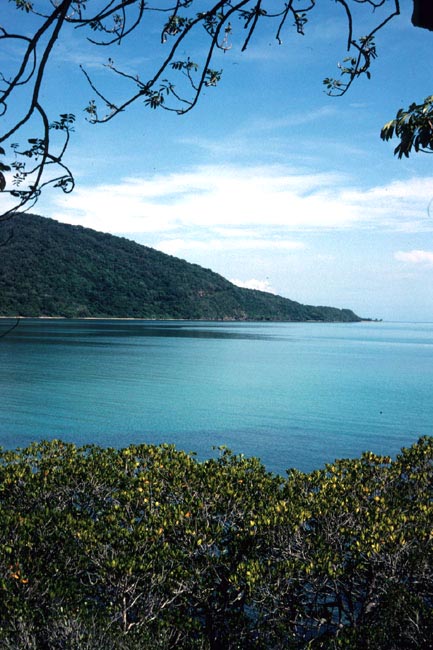
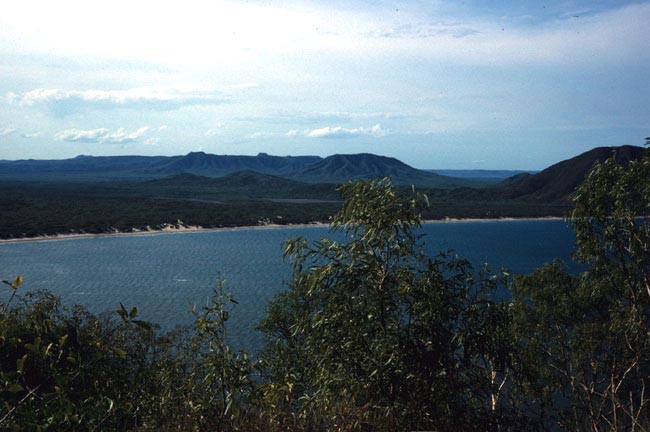
Cooktown is at the end of the track. Almost. About 2000 km north of Brisbane, Cooktown is the largest town on Cape York Peninsula. And as journalist John van Tiggelen says, it's a town of character and of characters.

There are two roads in (and out, I suppose). The fastest is the Peninsula Developmental Road, which runs inland through a gently undulating landscape of savannah and open woodland. The road heads north to the tip of the Cape but Cooktown-bound travellers turn off at Lakeland. A more leisurely route is the Bloomfield Track, which cuts through coastal rainforest, much of it in the Wet Tropics World Heritage Area. The two roads join just north of Helenvale.
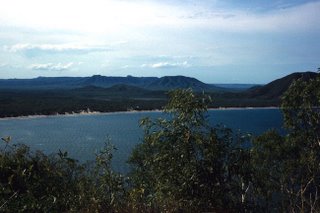
Cooktown has a long European history. (European readers, remember that 'long' is relative in Australia.) In 1770, Captain James Cook beached HMS Endeavour at the mouth of the river to repair the hull after it was damaged on the reef. Naturalists Joseph Banks and Daniel Solander wandered off to collect specimens. This is the place where the word 'kangaroo' was first recorded.

Since Banks and Solander collected material there, many biologists have visited the area. According to CYPLUS (Cape York Peninsula Land Use Study), Cooktown and the Endeavour River are type localities for 79 species of animals and 11 species of plants. That information is way out of date (the report was compiled in 1995). No doubt many more species have been described from the region.

Cooktown isn't on the tourist map in the same way as the Daintree or Port Douglas but I like it. It's a world apart. Once a gold town (it sprung up in October 1873 when two boatloads of miners arrived to work the Palmer River gold fields), its fortunes followed that of the mines. It declined in the early 1900s as the gold ran out.

Despite regular cyclones, many of the old buildings remain. Cooktown is undergoing a resurgence. Visit while it's still authentic.

James Cook Museum
St Mary's Convent (founded 1888) is now the James Cook Museum. First a school, then a U.S. Army base during World War II, the building was abandoned after the war. It was all but flattened by a succession of cyclones. The convent was restored and opened as the James Cook Museum in 1970. (That's a James Cook University vehicle outside the James Cook Museum.)

The tragic tale of Mrs Watson
Captain Watson fished for beche-de-mer (sea cucumber) in the waters of the Coral Sea. He and his family lived on Lizard Island, where they were attended by Chinese servants. The good cap'n headed off to get his haul of beche-de-mer, leaving wife and baby son behind. What they hadn't counted on was the wrath of the local Dingaal people, to whom the island was a sacred bora ground. Mrs Watson, son Ferrier and servant Ah Sam escaped in an iron tank, which had been used to boil up beche-de-mer.

They landed at one of the Howick group but found no water, so moved on to another island. That was also dry. Slowly, the three of them died of thirst. They are buried in Cooktown Cemetery. Mrs Watson's death is commemorated in a memorial drinking fountain in the main street. (Shades of the Harold Holt Swimming Pool there.)
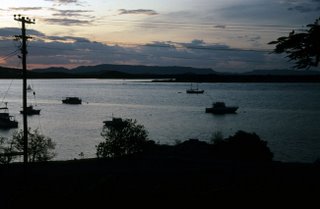
(Incidentally, the tank is in the collection of the Museum of Tropical Queensland, Townsville. I'm not sure if it's still on display. The tank is perforated with lots of small holes. Rust? Nope. When the group's remains were found several months later, the tank was full of rain water. The recovery party had to knock holes through the iron to let the water out.)

Stars of the forest

You've got to love fungi. They're weird. They're wonderful. And, at this time of year, they're taking over the place.

Puffballs come in all shapes and sizes. You might be familiar with the big, round soft puffballs (such as Lycoperdon), which release spores through a pore whenever they're touched. But these aren't the only sort.

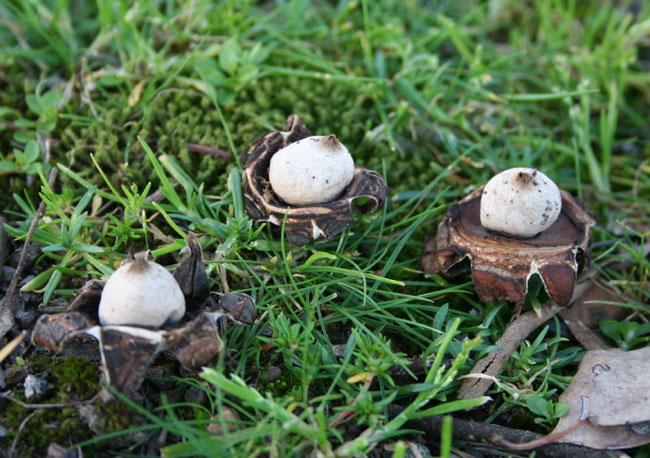
Earth stars (Geastrum) are also puffballs. Each starts off as a sphere. As it grows, the outer layer peels away into neat segments to reveal the spore-sac. In some species, the segments fold back so far they raise the fungus off the ground.

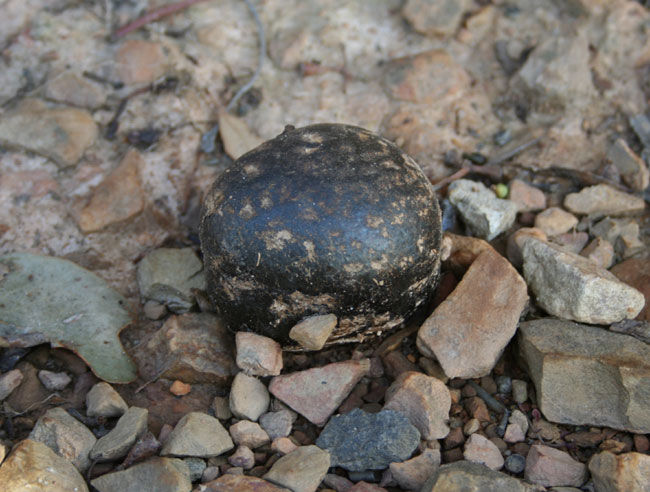
The horse dung fungus (Pisolithus) is often overlooked. After all, who gives horse poo a second glance? (That's a rhetorical question. Please don't send your answers to me.) Forget the unprepossessing appearance because Pisolithus is an important ectomycorrhizal fungus. It forms mutualistic associations with a wide range of plants, infiltrating the host's roots (in a good way) and providing it with nutrients. Pisolithus is easy to culture, so is widely used in forestry to help tree growth.

Read more
Anderson. I. (2000). Inter- and intraspecific variation in Pisolithus from central and eastern mainland Australia. PhD thesis, University of Western Sydney. (Thesis available as PDFs)

Fungimap, the place for fungi fans in Australia

CSIRO's site on ectomycorrhizal fungi

Tom May on identifying earth stars

[Thanks to Randall, who found these specimens on a fungus foray on his property NE of Melbourne.]

Saturday, 19 August 2006

Deep Sea News has a beaut series called 25 things you should know about the deep sea. They're up to number 14.

Previous posts include:
  • Where Deep-Sea Organisms Come From
  • Variety of Organisms
  • Sampling the Deep is Difficult
  • Variety of Habitats
  • Patterns Linked to Surface Production
  • Miniatures of the Deep
  • Deep-Sea is Under Threat
  • Undiscovered Species
  • High Species Diversity
  • Unexplored Deep
  • The Deep-Sea is Huge!
  • The Definition of Deep Sea


Check it out.

Better than a cat ...an octopus(s)

I was looking through all my old transparencies and found this one from the early 80s. I remember we had this little fellow and a blue-ringed octopus. (Not in the same tank.) This octopus was always quite shy whereas the blue-ring was rather more brash. If I can find any more photos, I'll scan them.

Missing lynx

The spider has a bad name: to most of us, she represents an odious, noxious animal, which every one hastens to crush under foot. Against this summary verdict the observer sets the beast's industry, its talent as a weaver, its willingness in the chase, its tragic nuptials and other characteristics of great interest.
J. Henri Fabre

Every garden has lynx spiders, Oxyopes, but they're not easy to spot among foliage. They are itinerant hunters. Instead of building webs, lynx spiders locate their prey by sight and leap on them in feline fashion.

Few people have turned their microscopes towards the Australian lynx spiders. We know something of their anatomy and systematics but very little of their ecology and life history.
My plans to sleep in for a ridiculously long time were thwarted this morning by the neighbourhood renovators. (Wooden cottages may look attractive but they need a lot of maintenance. Most of it involves hammering. For some reason, hammering at 9 on a Saturday morning is more effective than doing it at 3 in the afternoon.) (Unless I'm taking an afternoon nap, of course, in which case the street erupts in mass nail-driving activity. Oh, there it goes.)

Friday, 18 August 2006

What a croc(k)!

I imagine this decision also has an impact on the way that crocodiles are slaughtered and processed on farms. If they're classified as 'fish', they're probably dealt with in a different way from other farmed four-legged animals.


Australian lawmakers ponder the meaning of fish


Fri Aug 18, 2006 7:56 AM BST

CANBERRA (Reuters) - When is a fish not a fish? When it is a giant killer reptile with four legs and sharp teeth.

Politicians in Australia have been pondering the meaning of "fish" and have passed new laws making it clear crocodiles should be fish too.

The decision is at odds with the arbiter of the Australian English language, the Macquarie Dictionary, which rules that fish are "completely aquatic vertebrates, having gills, commonly fins, and typically an elongated body usually covered with scales".

The answer to the Australian meaning of "fish" is contained in the new Agriculture, Fisheries and Forestry Legislation Amendment (Export Control and Quarantine) Bill 2006, which was endorsed by Australia's parliament on Thursday.

Australia's junior minister for agriculture Susan Ley told parliament the new definition was needed to ensure Australia had the right to enforce export controls on a wider range of fish, including crocodile products, shellfish and prawns.

For the record, Australia's Macquarie Dictionary defines a crocodile as a reptile.

Source: Reuters
I'm off to other stuff this evening. I'll be back tomorrow with some bits and pieces. (We've got a new catch cry at work, loosely modelled on dialogue from 'The Castle': That's going straight to the blog.)

Remind me to tell you about the funeral.

Rieslings to be cheerful

Pseuds Corner is a regular column in British satirical magazine Private Eye. It exposes the week's most pretentious and affected writing. I suspect that wine reviews appear frequently on their shame file.

Leeuwin Estate, in Margaret River, Western Australia, is very proud of its wines. So proud that it's not afraid to include reviews like this:

A wine of astonishing purity and clarity. Crack this open for the unexpected smell of fresh rubber goods, followed by an injection of pure citrus-lime zinginess. As well as being poised and brilliantly made, this is also a picture of restraint. Think Coco Chanel in black rather than Fergie in a puffball. And once you've swallowed it's mouthwatering, razor-lickingly gorgeous. Stunning.

Joe Fattorini, The Herald (Glasgow) Magazine, 1st July 2006

Am I the only one disturbed by the smell of fresh rubber goods? Not to mention the razor licking ...

Thursday, 17 August 2006

Urchin on the ridiculous

A sea urchin offered for sale on eBay turns out to be a new species, according to Dr Simon Coppard at the Natural History Museum in London.

Read the story at the Guardian on-line: New urchin leaves eBayers all at sea.
More from Google Trends, the search facility that allows you to find out things you really don't need to know ...

(See this piece on Snail's Eye View for more information)

Search term: Penis enlargement

1. New Delhi, India
2. Chennai, India
3. Delhi, India
4. Orlando, UK
5. Miami, USA
6. San Diego, USA
7. St Louis, USA
8. Irvine, USA
9. Houston, USA
10. Tampa, USA


Search term: Cosmetic surgery

1. Dublin, Ireland
2. Miami, USA
3. Brisbane, Australia
4. Sheffield, UK
5. San Diego, USA
6. Bletchley, UK
7. Brentford, UK (First alien abductions, now this ...)
8. Edinburgh, UK
9. Birmingham, UK
10. Milton Keynes, UK

Rainforests in the alps

In winter, Mt Hotham in the Victoria High Country, is cloaked in snow. In summer, wildflowers cover the slopes. But 35–49 million years ago, the area experienced no snow fall. In fact, it was so warm that rainforests grew over the mountains.

Fossils excavated from around Mt Hotham include species similar to those found today in the rainforests of North Queensland and New Guinea. Among them are Cryptocarya, Gymnostoma, several tropical Proteaceae and the conifer Agathis.

Read more
Carpenter, R.J., Hill, R.S., Greenwood, D.R., Partridge, A.D. and Banks, M.A. (2004). No snow in the mountains: Early Eocene plant fossils from Hotham Heights, Victoria, Australia. Australian Journal of Botany 52(6): 685–718

Hill, R.S. (2004). Origins of the southeastern Australian vegetation. Philosophical Transactions of the Royal Society of London series B 359: 1537–1549.

A time of a whale

Twenty-five million years ago a small whale with big eyes and plenty of teeth patrolled the sea off southern Australia. Janjucetus hunderi was 'Australia's very own T. rex of the oceans' according to Erich Fitzgerald, the Monash University PhD student who described the animal in the latest issue of Proceedings of the Royal Society B.

Fossil whales are always of interest but what makes this one the toast of the town is its teeth. Modern whales are divided into two groups on the basis of what's in their mouths. Toothed whales (such as sperm whales, killer whales and dolphins) have rows of peg-like gnashers. Other whales possess curtains of hairy baleen, which act as filters to strain out krill and small animals from each giant mouthful of water.

Janjucetus had teeth. So that makes it a toothed whale, right?

Wrong. It's a baleen whale. It just doesn't have any baleen.

Filter-feeding evolved relatively recently in whale history. Baleen whales are descended from toothed ancestors. (Embryonic baleen whales show evidence of this. They start to grow tooth buds but the buds are reabsorbed before they develop fully.) Janjucetus is one of the earliest in the group. It possesses many of the anatomical characteristics of baleen whales—except for baleen. That evolved much later. It first appeared alongside teeth. Then the teeth disappeared and the baleen remained on its own. One-at-a-time predators became bulk filter-feeders.


Read more
The Loom has an excellent article on Janjucetus and its significance in the whale family tree.

New Scientist article on Janjucetus.

Wednesday, 16 August 2006

Electric Fuseli

When I was at secondary school in London, I used to visit the Tate Gallery about once a month. I was fascinated by the Gothic nutters—Richard Dadd, who murdered his father (nominative determinism at play there) and painted his best work at Bedlam; watercolourist, engraver and poet William Blake; and Henry Fuseli.

Fuseli was Swiss but moved to England in his 30s. Much of his work is inspired by the darker elements of Shakespeare, Milton and classical mythology. His best-known piece is The Nightmare, in which a demon sits on the stomach of a sleeping woman. It received great praise when exhibited at the Royal Academy in 1782.

William Blake was no great fan of the Academy but had time for Fuseli, even though the Swiss artist was part of 'the Establishment'. Blake, who wrote visionary poetry, including Jerusalem, The Tyger and A Poison Tree, penned some lines to celebrate his friend. Of Fuseli, he said:

The only man that e'er I knew
Who did not make me want to spew


Who wouldn't want to spend their Sundays with these people?

Tiger beetle, burning bright

(With apologies to William Blake, although he no doubt would have written about tiger beetles if he'd seen some of the more spectacular species. His loss.)

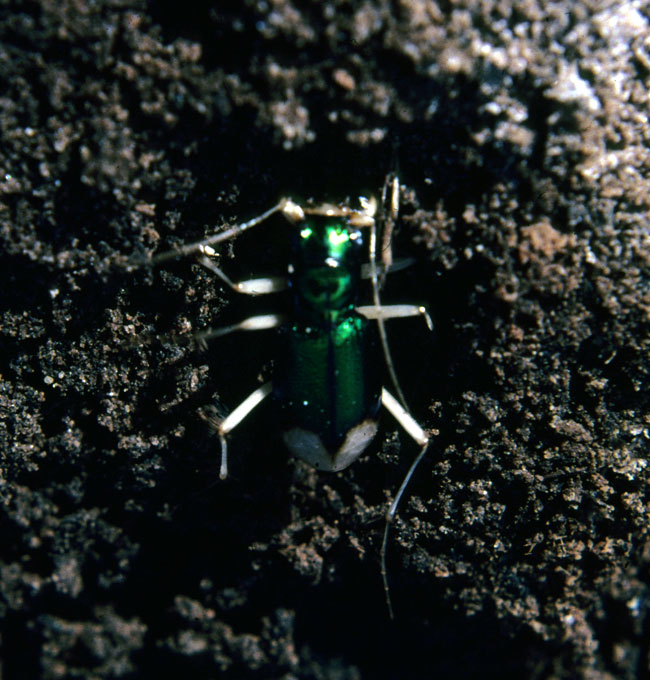
Salt pans are inhospitable places for wildlife. Even the vegetation has a hard time. But the green tiger beetle Megacephala australis lives and hunts its prey on the dry beds of salt lakes in inland Australia from Alice Springs to the Wimmera.

I found this animal at Lake Tyrell, near Sea Lake, in NW Victoria. The species is active for most of the year, starting to move in August and settling down again in May. They are strongly associated with salt lakes but hunt for insects on sand dunes in the mallee and along the edges of freshwater swamps.

Many species of Megacephala occur in Australia, South America and Africa, with a much lower diversity in the northern hemisphere. McCairns et al. (1997) regard Megacephala as a Gondwanan genus which has spread northwards from the southern continents.

(And that's my old car, a 1969 Holden Premier with bronze duco and blood-red interior. I airbrushed out dents.)

Read more
McCairns, R.F, Freitag, R. Rose, H.A. and McDonald, F.J.D. (1997). Taxonomic revision of the Australian Cicindelidae (Coleoptera), excluding species of Cicindela. Invertebrate Taxonomy 11: 599–687.

Watson next?

The Festival is in full swing in Edinburgh. That's not of much interest to me because I'm on the other side of the world. But I notice things. And one of the things I noticed was Welsh comic Mark Watson doing a 36-hour session of stand up comedy. I say Welsh, because he does his stuff in a broad accent, although he apparently bungs it on. And I say stand up but I suspect that by hour 30, he'll be sagging.

He is a very funny man. I saw him at the Melbourne Comedy Festival this year and almost needed an oxygen mask because I was laughing so much I had difficulty breathing. I wasn't the only one. There would have been a big fight for the oxygen cylinder among the cyanosed audience.

Watson wrote a novel at the age of 23. (And it was published, which is even more impressive.) But that was years ago. Well, three, to be accurate. So now he's writing another one—with the help of his audience.

The novel-writing show is Watson's effort to synthesise these two strands of his work. It's another event that is uniquely Edinburgh, in which Watson reprises the work-in-progress to his audience each day, then solicits suggestions for the next instalment. So far he's got a story about a newspaper sub-editor who is mistaken for a secret agent. Watson has to write a chapter a day, which amounts to a great social-life sacrifice in Edinburgh, but he finds it worthwhile to explore "whether it is possible to write something by this unusual process". And is it? "There probably are quite sensible reasons," he says circumspectly, "why you shouldn't try to write a novel in this length of time."


Read more
The show must go on and on, Guardian, 15 August 2006-08-16
From New Scientist, 5 August 2006:

SEARCHING for the meaning of life? If a higher power can't help, then there's always Google. Last week it transpired that people in India lead the world in searching for "nanotechnology" on Google (29 July, p 25). Now we find that the people of Brisbane, Australia, come top in their eagerness to type "meaning of life" into the search engine. (We also spotted that the city comes top for the word "aliens", but the two probably aren't linked.)


So I had to have a look. Google Labs provides a search engine called Trends that allows you to check who's interested in what on a global scale. It covers Google searches from 2004.

The results for alien abduction:
1. Perth, Australia
2. Brisbane, Australia
3. Seattle, USA
4. Brentford, UK (No, really. That's what it says.)
5. Birmingham, UK
6. Santiago, Chile
7. Los Angeles, USA
8. Melbourne, Australia
9. Manchester, England
10. Houston, USA

I must keep an eye on Brentford. Seems as if it's all happening there.

[Thanks to Menno for drawing my attention to the possibilities of this Google Labs gem.]

Tuesday, 15 August 2006

The weekly shot of Schadenfreude

This is old news but it's worth dusting off.

Vic Hislop makes a living by fishing for sharks. He used to kill great whites until they became a protected species in 2004. That was a sad day for our brave Vic. Nowadays, he restricts himself to unprotected species. Oh, and there's the shark 'museum' at Airlie Beach.
(I'm not sure how informative the museum displays are. I haven't visited. But I'm doubtful about the quality of information. In an interview following a fatal attack in South Australia, Hislop referred to sharks as 'a massive blight on marine life'. That makes me wonder just a little bit about his understanding of ecology.)

Melbourne newspaper, the Sunday Age, ran a story about his encounter with ageing Young British Artist Damien Hirst, the man with the penchant for shoving things in formalin. (Here's a tip from someone who's worked in natural history museums for quite some time—fix in formalin, preserve in ethanol, Damo.)

Hislop has supplied sharks to the artist for 15 years. It seems to have been on a no-questions-asked basis.

Mr Hislop went fishing last year on a request from Hirst, who had ordered three big tiger sharks and a white pointer for his ongoing artistic needs.

"I caught this beautiful-looking little tiger, so I chucked it in as a freebie," Mr Hislop explained.


Imagine how he must have felt when the Sunday Age told him that the beautiful-looking little tiger had been sold to the Samsung Gallery in South Korea for … A$5.7 million.

Snail trails

When I go beachcombing, I usually head south-west to Barwon Heads or Apollo Bay or occasionally as far as Portland. But every now and then, I visit the other side.

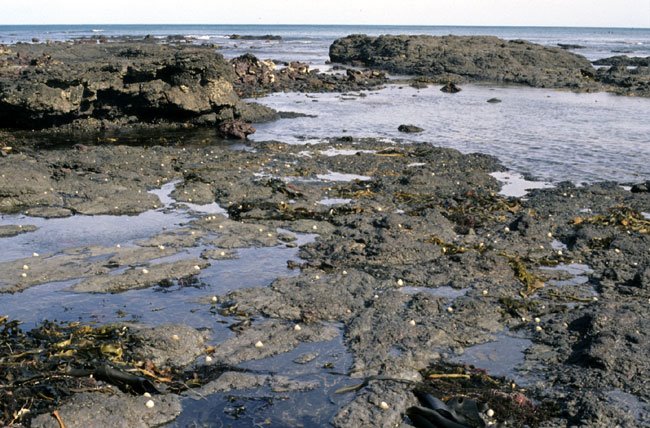
Flinders lies at the southern end of the Mornington Peninsula, about an hour and a half from Melbourne. The platforms of black basalt from the Older Volcanics (laid down in the Eocene, between 36 and 53 million years ago) are home to a high diversity of molluscs.

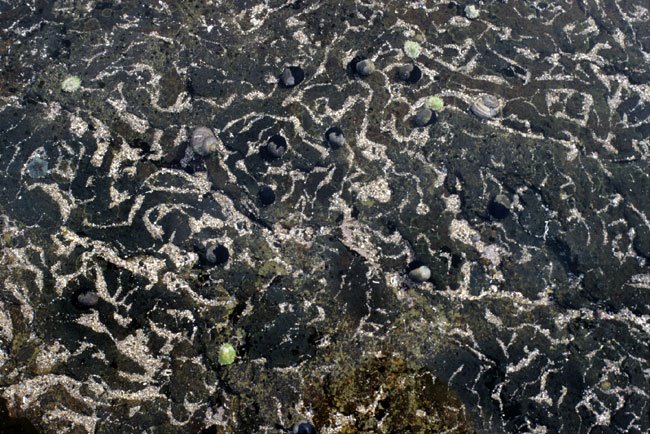
Perhaps the most abundant snails are Nerita atramentosa. At low tide, they cling to rocks, holding on tight to avoid desiccation. When the waves roll in, they emerge to graze on the veneer of algae laid down by the sea. Nerita atramentosa is the modest cousin of more exuberant tropical species, many of which are reknowned for their patterned shells. But what it lacks in colour, it makes up for in persistence. This species is the only temperate nerite in the world. Although its main distribution is southern Australia and New Zealand, it has also colonised Easter Island. Now that's impressive.
Apologies. Dimwit* here decided to fiddle with the template and lost all the links before deciding that the original version was just fine.

I will restore normal service as soon as possible.


*That's me, in case anyone thought I was pointing the finger.

Monday, 14 August 2006

Unk. male, greying hair, blue eyes, about 55 yrs, false upper dentures, bull neck, very solid build. JACKIE tattooed on U.L.A. Heart below elbow. Old scald mark at back of left arm.


Although there were no documents on his body, police identified my father from his fingerprints, which they had on record from his various stints as a burglar and who-knows-what-else. My uncle George visited the Coroner's Court and confirmed the identification. That couldn't have been a barrel of laughs for him. In that stilted style of witness statements, the form concludes:

I didn't see him very much. He did drink a bit. I've seen him drunk. I couldn't say how he acted when drunk. I don't know where he worked.


On the same day, the pathologist Robert Charlton performed the post mortem examination and completed his report. He found that, although there were few external signs of trauma, Dad had suffered from a linear fracture of the skull. The crack extended from above the left ear across the back of the skull almost as far as the right ear. The varying width of the fracture suggested that the point of impact was on the right side.

What killed him was the gross subdural haemorrhage affecting the left side of his brain. The pathologist thought the contre coup injury indicative of:

... the (moving) head striking a fixed hard object making contact in the right occipito-parietal region.


Moving was added as an afterthought.

Charlton referred the case to the Homicide Police.

Detective First Constable Noel McCracken from Prahran CIB performed a cursory investigation at what was described as 'a later date'. He and Schipper went to the rooming house in Windsor where Dad lived and 'found nothing of any significance'. A hand-written note at the end of McCracken's deposition said 'Found no enemies of this man'. Sounds like laziness to me. But Prahran police were no doubt overloaded with dead derelicts in the 1960s. (And they probably still are.) How much time could they afford to spend on each one?

Did Dad fall over in a drunken stupor and crack his skull on the cobble stones in Barry Lane? Or was he murdered? The reports and witness statements waggle their fingers towards the former, but the Coroner couldn't decide.

The witness statements of his friends are fascinating. Graham John Carey, a drainer who had lived at Barry Street but had moved away by the time of the inquest, had a particularly interesting story to tell.

This is his deposition.

On Friday, the 7th October 1966, I was drinking at the Royal Exchange Hotel, in Commercial Road, Prahran, with a friend Nick, I do not know his other name but he is a bar-man at the London Hotel.

We drank there until closing time and we left the hotel about 10:10 p.m. I only had a couple of drinks that night because I was working late and I was sober.

After we left the Hotel, we walked home along Osbourne Street and over the railway bridge and then down Grovesnor Street and along the lane that runs along the back of the Shops in Chapel Street. We were walking towards Barry Street in the lane when I saw Ian SCOTT lying in the lane. He was lying on his back with his arms and legs spread right out, and his head closer to Grovesnor Street. He had a smile on his face and I thought he was in a drunken sleep.

I am not certain what he was wearing but I think it was a jumper and trousers and the zipper on his jumper was undone.

This time that we saw him there would have been about 10.25 p.m.

There was no other person about at the time


But there was more hand-written testimony after that.

I knew deceased—he used to come around home on Saturday morning for breakfast.

I've seen him under the influence many times. I've seen him fall over in the hotel but never outside the hotel.

When I saw him this night I thought he was drunk and having a sleep. I didn't try to touch him as he'd said in the past 'leave me where I flake'. I thought he'd sleep it off there O.K.

It is a cobble stone lane. I suppose you could slip on them but I doubt it very much.

Lighting is very dark in lane. I thought it was [illegible] in the lane. I couldn't see what it was. We did intend to go this way. We found him by accident and thought he was asleep
.


Was he trying to tell the police something? Or did the statement style just make him sound like a plonker?

You be the judge.

Sunday, 13 August 2006

On this day

I so hope this is true. Thank you, Wikipedia, for this gem.

Otto Witte (1868–August 13, 1958) was a circus acrobat who managed to be crowned King of Albania.

In 1913, when Albania broke off from the Ottoman Empire, some Albanian Muslims invited Halim Eddine, a nephew of the Sultan, to come and be crowned king. Noticing his own resemblance to Halim Eddine, Witte traveled to Durres, Albania, with a friend, the sword-swallower Max Schlepsig. He succeeded in being crowned king by the local troops on August 13, 1913. Over the next five days, he enjoyed a harem and declared war on Montenegro before his ruse was discovered. Taking a substantial portion of the kingdom's treasury, he and Schlepsig managed to escape the palace with the aid of the harem and they eventually made their way out of Albania.

His story was adapted for Harry Turtledove's fantasy novel Every inch a king.

Later in life his official identity card, issued by the Berlin police, stated that its holder was "a circus entertainer" and "one-time King of Albania".

Reference
The Man Who Was King, Time Magazine, 25 August 1958.
Yesterday I told you something of my father's short-lived careers as a gunner and a criminal. (Although I'm not so sure that he didn't spend a rather longer time as the second. I only have his Victorian police record from 1938 to 1942.)

I thought that I'd find out a little more through the magic of the Web, so I searched the state archives and got a copy of his death certificate. This is where it got interesting.

He hadn't died in 1963 as I'd thought, but in 1966. And he didn't die of a stroke, which is what I'd been told. The death certificate said cause of death was 'effects of cerebral injuries received'. It also noted that there had been a coronial inquest in February of the following year. The death certificate had been issued in March 1967.

An inquest? I couldn't let that one slip past.

An inquisition for our Sovereign Lady Queen Elizabeth II ....

The State Coroner, Harry William Pascoe, recorded his verdict:

[He] died from the effects of cerebral injuries received the day previous in a lane off Barry Street, Prahran, aforesaid under circumstances which the evidence adduced does not able me to determine.

Now I was really interested.

The police report of death for the coroner (completed by Constable G.J. Schipper) said:

Body was found in lane off Barry Street, Prahran by passing motorist who informed Ambulance on road who in turn conveyed to Alfred Hospital.

In fact, he was still alive when the ambulance picked him up. He died at the Alfred Hospital twelve hours after admission. During that time he remained unconscious. Because there were no obvious signs of trauma, the attending physician, Dr Heather Manning, assumed that he'd suffered a stroke. The pathologist would uncover the real cause of death later.

But at this stage they still didn't know who was lying on a trolley in the mortuary. Constable Schipper concluded his report:

No sign of anything in clothing that could be of assistance to help identify deceased. Missing persons informed of unknown male at Alfred Hospital and deceased is listed under serial No. 5304 at missing persons

I'll tell you the rest tomorrow.

A water penny for your thoughts

Water has left its mark in the Centre. It carved the gorges and sculpted Kata Tjuta and Uluru and wore ancient mountains into plains of sand. That was in a wetter time. There's not much evidence of water in the heart of the continent now.

But it's still there.

While most zoologists concentrated on the biogeography of land animals in the Centre, Jenny Davis and colleagues from Western Australia studied the distribution of freshwater invertebrates. They focussed on the George Gill Range near Watarrka (Kings Canyon), which is the wettest place in the desiccated heart. It has also experienced the smallest amount of damage from human activity. Although the streams are ephemeral, running only during rare floods, water holes among the rocks provide a permanent habitat for freshwater animals. They act as refugia from which animals disperse when the creeks flow again.

The team found no great surprises in the number of species in these water holes—the usual suspects were there in the usual quantities. More ostracods, copepods and chironomids than you could poke a stick at. But there were some notable anomalies.

There were no stoneflies, isopods or amphipods. In fact, they found very few of the shredders that normally feed on fallen leaves. Maybe there weren't enough leaves to support them?

But they did find some animals that couldn't move around much—among them, the waterpenny (Sclerocyphon fuscus), a small psephid beetle. It was almost certainly a relict species, stranded in the central ranges when the continent started to dry out.

What were the biogeographical relationships of the George Gill Range fauna? Although many species were cosmopolitan, occurring in suitable habitat across the continent, the waterpennies and others were distinctly southern in distribution. The strongest biogeographical signal suggested a central and south-east relationship. But the dragonflies showed another pattern—albeit weaker than the others. Their affinities were to the north-west.

So what's the story? And why haven't I mentioned snails yet?

Thank you for reminding me. I can't answer the first question but I can draw comparisons with the land snails. With their distinct northern affinity, the Camaenidae show a similar pattern to the dragonflies. In contrast, Bothriembryon sides with the others and has a southern connection. What makes that genus unusual is that the southern link includes the south-west, something the aquatic animals don't show.

Read more
Davis, J.A., Harrington, S.A. & Friend, J.A. (1993). Invertebrate communities of relict streams in the arid zone: the George Gill Range, central Australia. Australian Journal of Marine and Freshwater Research 44: 483–505.

Saturday, 12 August 2006

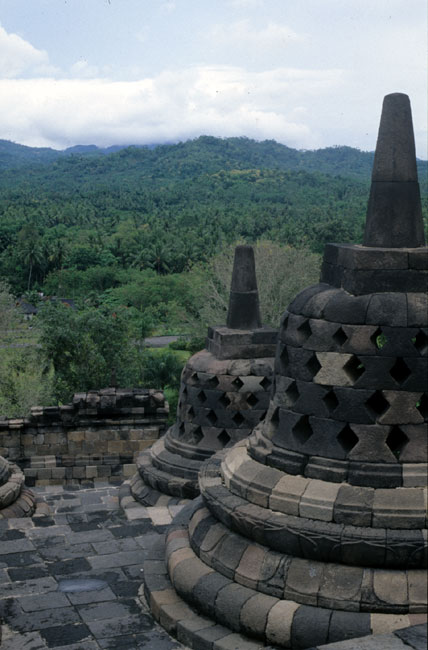
I wasn't quite as close to this eruption as I was to that of Anak Krakatau but I was impressed by it nonetheless.

This is Gunung Merapi near Yogyakarta in central Java. The southern coast of Java lies close to the junction of two tectonic plates. Such close proximity to a subduction zone (where one plate slides beneath the other) means the area is prone to earthquakes and volcanic eruptions.

I was at the ancient Buddhist temple of Borobodur when Gunung Merapi did its thing. Almost a thousand years before, the volcano buried a huge area of central Java in volcanic ash. Borobodur was left to the rainforest, which quickly smothered it. It remained hidden until Stanford Raffles rediscovered it in 1814. Restoration proceeded slowly. Borobodur and the neighbouring Hindu temples of Prambanan are now listed as World Heritage Sites.

Dick of the month

That March had been an eventful month for Dick. The apparently mundane arrival of a delivery woman whose necklace bore a Christian fish symbol had triggered a cascade of bizarre impressions. He thought his unplugged radio was insulting him, his cat was trying to tell him something of vital significance, and that the KGB were sending him post-hypnotic triggers in the mail.

Well, we've all had days like that.

But speculative fiction writer Philip K. Dick seems to have spent most of his life in this condition. It explains his obsession with drug-induced alternative realities in works such as A scanner darkly, Do androids dream of electric sheep (the short story that gave rise to Blade runner) and We can remember it for you wholesale (which became the dreadful Schwarzenegger vehicle Total recall).

Weird stories from a weird man. The Guardian's book section has an excellent article about him, his taste for pharmaceuticals and the continually changing perception of reality they granted him.
Check out this video on Pharyngula: Ricky Gervais explains Genesis.

(Warning: May contain traces of the F word)

No courage in these convictions!

I've got some more natural history words and pictures to post—I'll do that later today. But right now I thought I'd share something of my background with you.

Don't panic. This is not a therapy session.

My father died when I was young. My mother didn't seem to have been terribly fond of him so there wasn't a great deal of discussion of the topic at home. Well, the occasional story about how he used to roll up at home with a case of beer and a bunch of mates and the odd dead kangaroo. (I don't know any more. Don't ask.) And the time that Mum shot him through the foot. Apparently, accidentally, but the nurses at the hospital weren't convinced. So recently, I thought I might make a small effort to find out a bit more about him. (And you'll see just how small the effort was.)

My mother and my father's sisters and brothers are all dead, so there was no opportunity to get the information from them. But Dad was born in 1918. (Before you ask, my parents were quite old when I arrived.) That meant he would have been the right age to serve in World War II.

Off to the Australian War Memorial web site to search through their database. I found him and his service number and requested a copy of his records. All this without leaving my chair.

The records are extensive. He enlisted in Prahran on 11th December 1941 at the age of 23. He was discharged on 3rd November 1943, having spent 598 days AWOL.

But that wasn't the reason for his discharge. Oh, no. He was out of the Army because he'd been 'sentenced to penal servitude by a civil court'.

The AWM had included his police record. Now, Dad was born in Tasmania and I'm not quite sure when he arrived in Victoria but I'd imagine it wasn't long before the 18th June 1937, when he was arrested for larceny in a dwelling. In 1938, he served time for possession of a pistol (three months) and garage- and shop-breaking (three years).

A period of calm followed. He'd kept his nose clean. Or maybe he just hadn't been nicked. Then, on 6th November 1942, he was sentenced to another two years for housebreaking. This seems to have been the last straw for the Army. Or it would have been if they had been able to find him.

Well done, Dad.

It doesn't end there. I'll tell you the second part of the story tomorrow.
That'll teach me. I was watering the pot plants (plants in pots, that is, not the other sort) and had to lean over quite a long way with a full watering can in one hand. Now my lower back muscles have registered a complaint about mistreatment. I will be moving gingerly for the rest of the day and lifting nothing heavier than a tea cup. Oh, buggrit! Let's throw caution to the wind. Make that a mug.

Friday, 11 August 2006

What I'm reading ...

...A Rum Affair: a true story of botanical fraud by Karl Sabbagh. This is an investigation of alleged scientific fraud by botanist John Heslop Harrison. In an attempt to give more credence to his idea that the Scottish island of Rum (then called Rhum) was a refugium for plants during the Ice Age, Heslop Harrison did a little gardening. But he was rumbled by a colleague. (Those botanists—they're all feral. Pathologically neat but feral.)

The Skeleton Man by Tony Hillerman. I am just about to start this one. It's another Leaphorn and Chee story set in the South West.

I've also got the latest James Lee Burke—Pegasus Descending—but I won't begin that until I've finished the Hillerman. I need to bring a bit of discipline into my life.

Thursday, 10 August 2006

Shhhh ...

Welcome to the official website of the Secret Intelligence Service (SIS)

Am I the only one who thinks it's a bit strange that Britain's MI6 has a web site? Okay, MI5 is one thing but MI6? Aren't they supposed to be secret? Sure, they've got a bloody great big building on the bank of the Thames at Vauxhall Cross and we know that C is called John Scarlett, but still ... they've even got a web page in Russian.

The secret service just isn't trying any more.

Don't mention the wart

If you meet a camaenid snail, sneak a glance at the wart on its head. It lies between the two upper tentacles. Well, when I say lies, it stands out like a dog's ... er ... wart. Now check the bonce on a garden snail. No peculiarity there. It's all smooth and slimy.

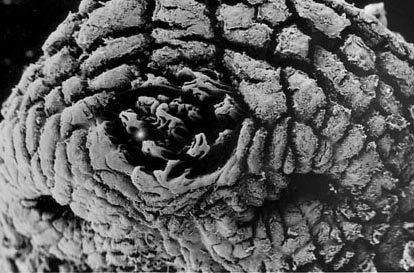
Of course, there's a chance you might miss it on a camaenid. Not all species have a head wart. And of those that do, not every one parades it around. The big tropical Hadra and allies have a head wart they can tuck away into a little pocket when not needed. Here's a picture of one proudly on display. The tentacles have been retracted into those two slits in the head. (This photograph was taken with a scanning electron microscope. I don't get to play with SEMs anymore. Sob.)

So what does the head wart do? It probably has a role in courtship. Certainly, there's evidence that the same structure in bradybaenid snails has a reproductive function—it may even secrete pheromones. Neither the skin (epithelium) cells nor tissue of the camaenid head wart appear to produce much in the way of secretions, but there are big spaces that may store products from elsewhere. I dunno.

But odd as it is, the camaenid head wart fades into a mere blemish when compared with the frontal organ of the African slug Gymnarion. Like the head wart, the frontal organ sits between the upper tentacles and can be everted at will. The difference is that in some species of Gymnarion it's armed with hooks made of calcium carbonate. Apparently, the courtship of the barbed species is longer and more complex than those of the unbarbed species. I'm not surprised.

[Thanks heaps to Josh for scanning the photo]